A Spanish verb changes to match who is doing the action. That is conjugation. In our lesson, 24 Common Spanish Verbs 🥑 Easy Conjugation Charts & Real Examples, Professor Avo takes you from hablo to digo one small pattern at a time. Here are all 24 freeze-frame charts, each with a short tip and an example you can say today.
Watch, pause, and try it aloud
Watch the full lesson here for free. Each chapter introduces a pattern, models the Spanish, and gives you a turn before the answer. Start with one chapter and return when you are ready for more.
Tap any chart below to open the full-size learning asset. For larger, selectable text on your phone or screen reader, open Read the five forms as text under that chart. “Hear this verb” takes you straight to its place in the lesson.
Watch Spanish verbs made easy with Professor Avo
A free 1-hour, 6-minute lesson: 24 charts, 72 everyday examples, slow speaking practice, and time to try the answers yourself. Subscribe to LSFR for more lessons; YouTube will ask you to confirm.
Pause, repeat, and try saying each example out loud. Watch on YouTube ↗
How to read Avo’s five-row charts
Find the person on the left, then read across to the matching verb. Yo means I; tú is informal you; usted is formal you. Nosotros/nosotras means we. Ellos/ellas means they, and ustedes means you all.
People sharing a row use the same verb form: él habla, ella habla, usted habla. These charts teach the present indicative in Latin American Spanish, using ustedes for a group. They do not cover vosotros or regional vos forms. Subject pronouns help you learn the rows; in conversation you can often leave them out when the person is clear.
1–3: One -ar pattern, three useful verbs
1. hablar — to speak; to talk
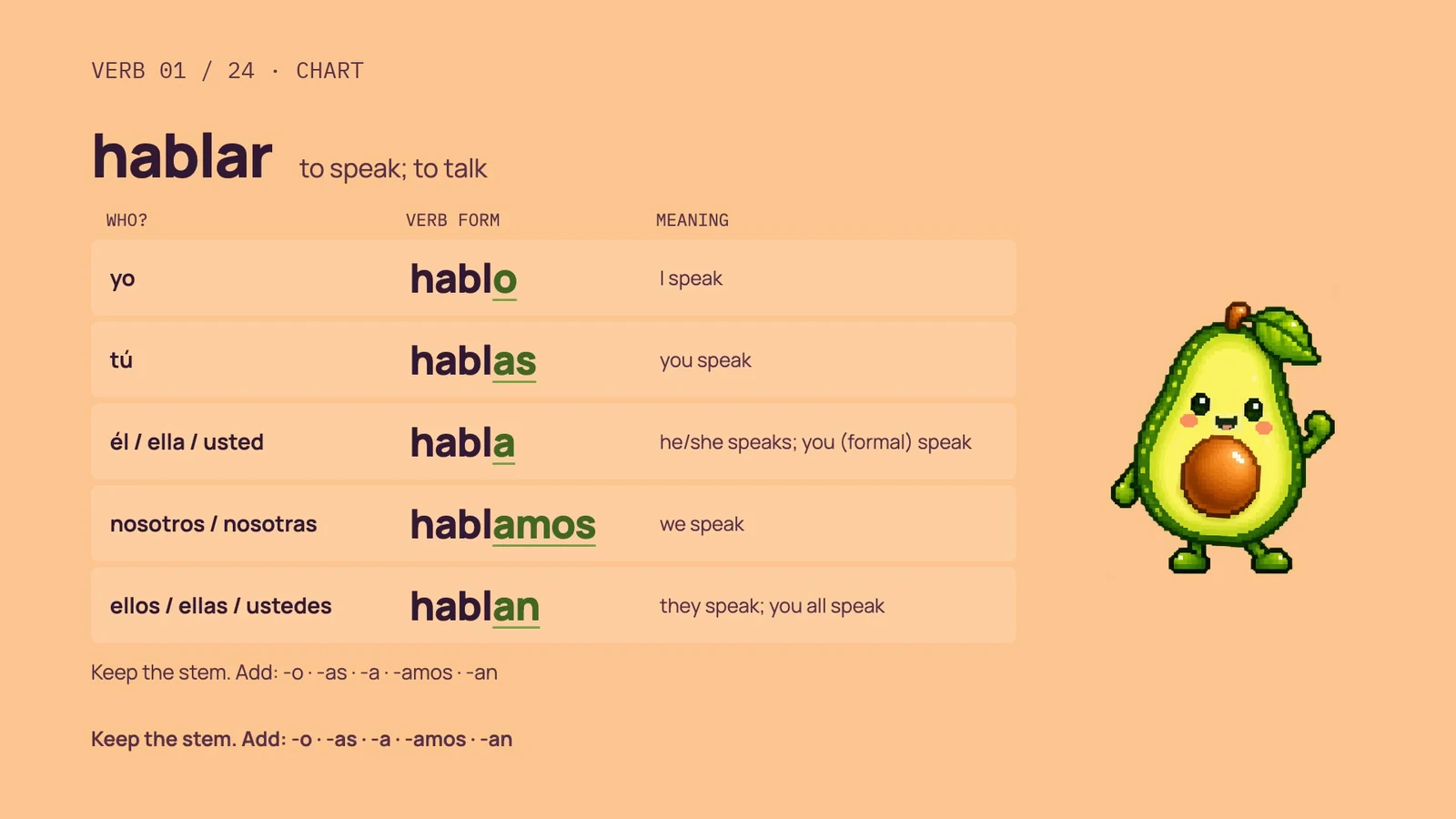
Avo’s tip: Keep habl- and change the ending: hablo for I, hablas for you, hablamos for we. The person chooses the ending.
Yo hablo español.
I speak Spanish.
Read the five hablar forms as text
| Who? | Verb | Meaning |
|---|---|---|
| yo | hablo | I speak |
| tú | hablas | you speak |
| él / ella / usted | habla | he/she speaks; you (formal) speak |
| nosotros / nosotras | hablamos | we speak |
| ellos / ellas / ustedes | hablan | they speak; you all speak |
2. trabajar — to work
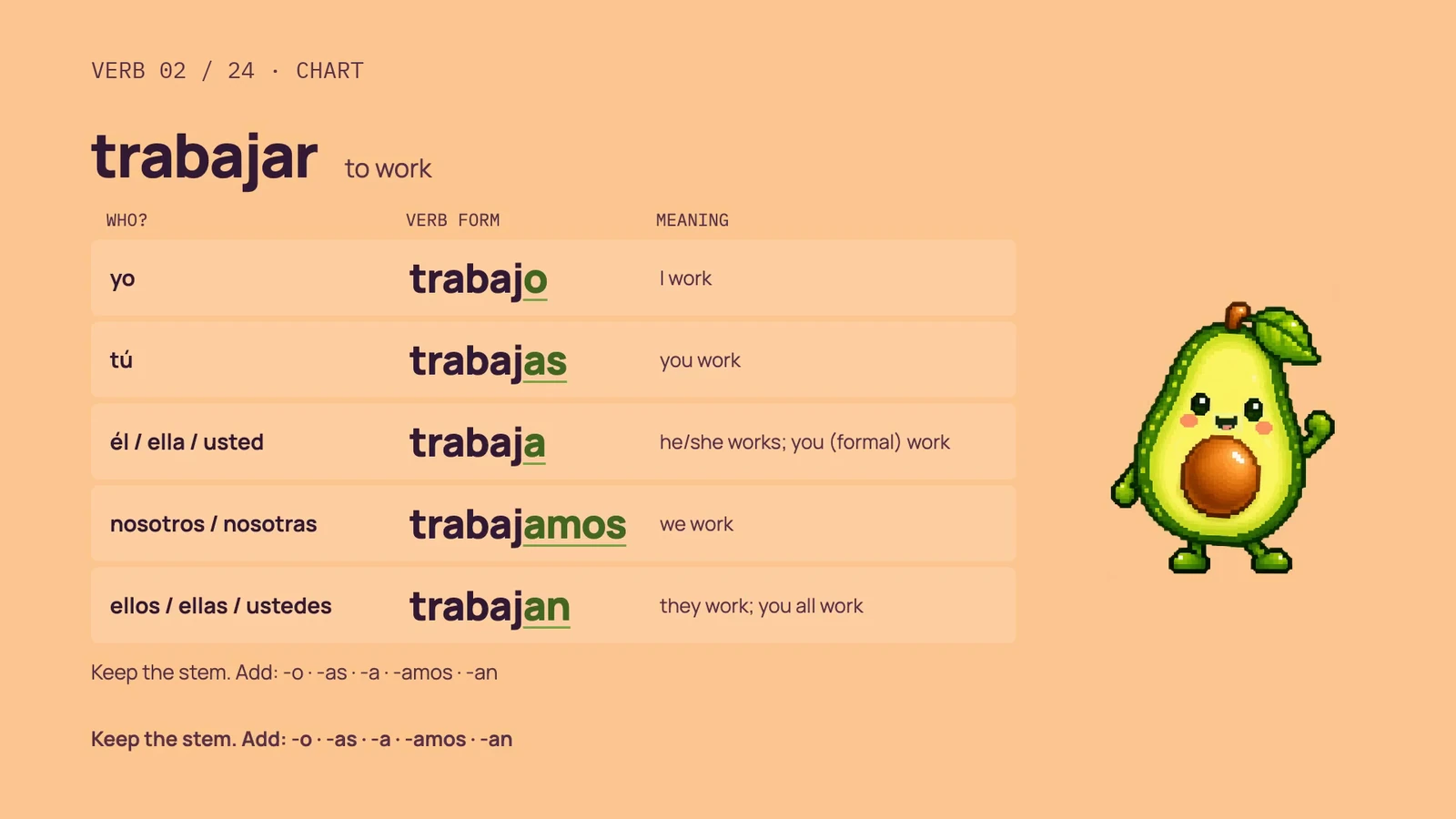
Avo’s tip: Trabajar follows the same -ar pattern. Yo trabajo can mean “I work” or “I’m working,” depending on the situation.
Yo trabajo aquí.
I work here.
Read the five trabajar forms as text
| Who? | Verb | Meaning |
|---|---|---|
| yo | trabajo | I work |
| tú | trabajas | you work |
| él / ella / usted | trabaja | he/she works; you (formal) work |
| nosotros / nosotras | trabajamos | we work |
| ellos / ellas / ustedes | trabajan | they work; you all work |
3. necesitar — to need
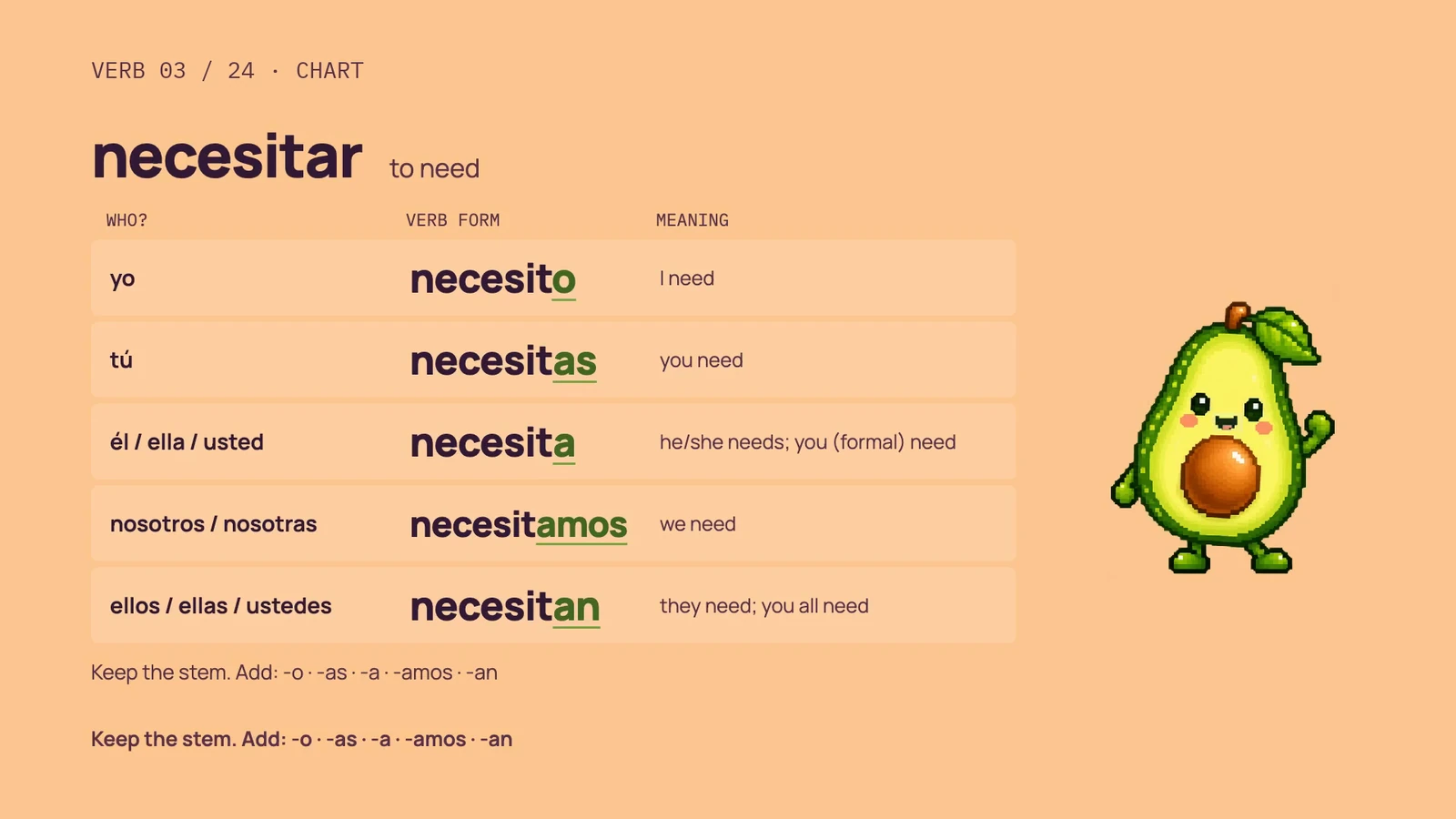
Avo’s tip: One more -ar verb, the same endings. Necesito agua means “I need water.” Reuse the pattern you already know.
Yo necesito agua.
I need water.
Read the five necesitar forms as text
| Who? | Verb | Meaning |
|---|---|---|
| yo | necesito | I need |
| tú | necesitas | you need |
| él / ella / usted | necesita | he/she needs; you (formal) need |
| nosotros / nosotras | necesitamos | we need |
| ellos / ellas / ustedes | necesitan | they need; you all need |
4–7: Regular -er and -ir endings
4. comer — to eat
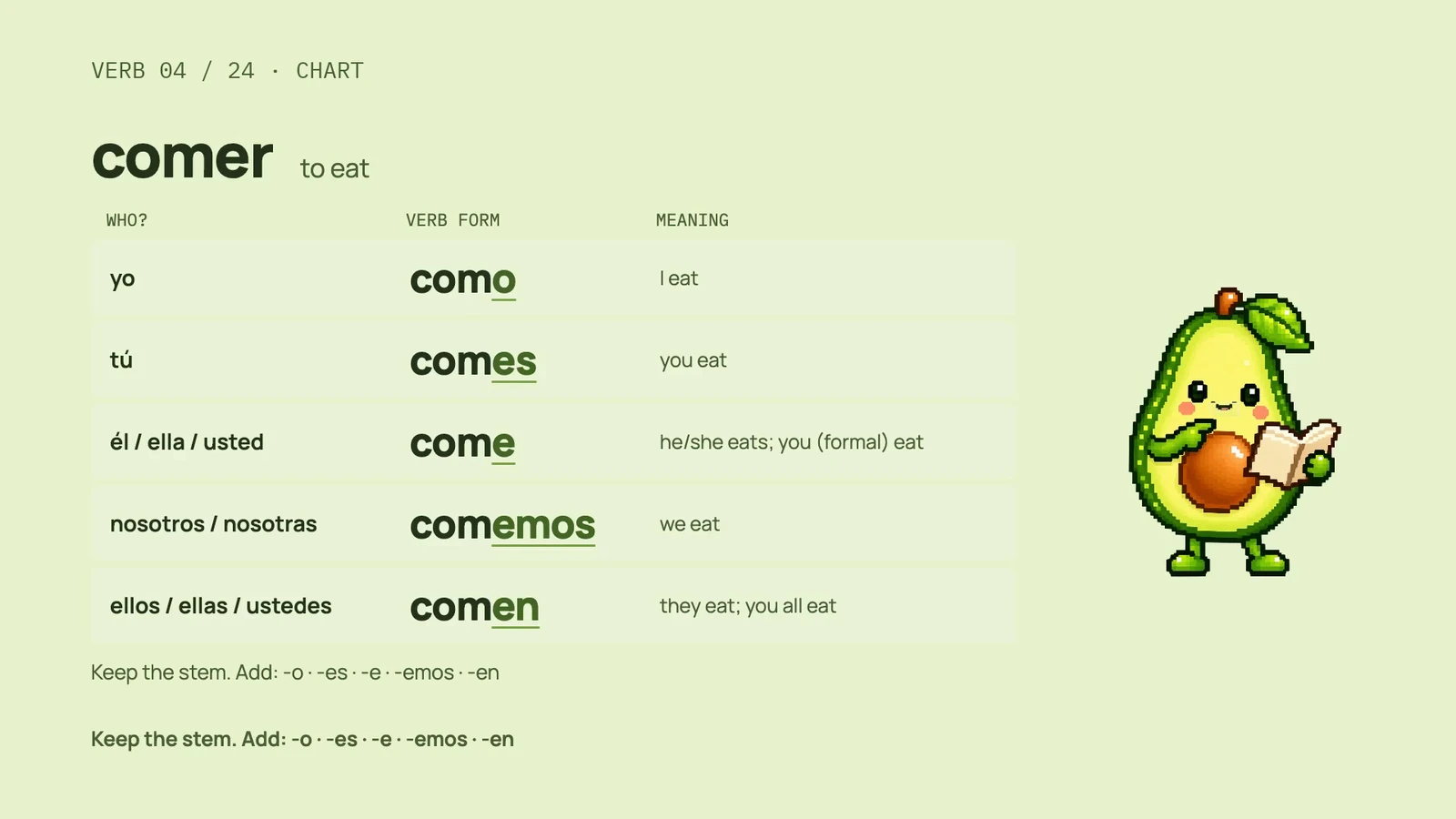
Avo’s tip: For regular -er verbs, keep com- and add -o, -es, -e, -emos or -en. Notice comemos in the we row.
Yo como pan.
I eat bread.
Read the five comer forms as text
| Who? | Verb | Meaning |
|---|---|---|
| yo | como | I eat |
| tú | comes | you eat |
| él / ella / usted | come | he/she eats; you (formal) eat |
| nosotros / nosotras | comemos | we eat |
| ellos / ellas / ustedes | comen | they eat; you all eat |
5. leer — to read
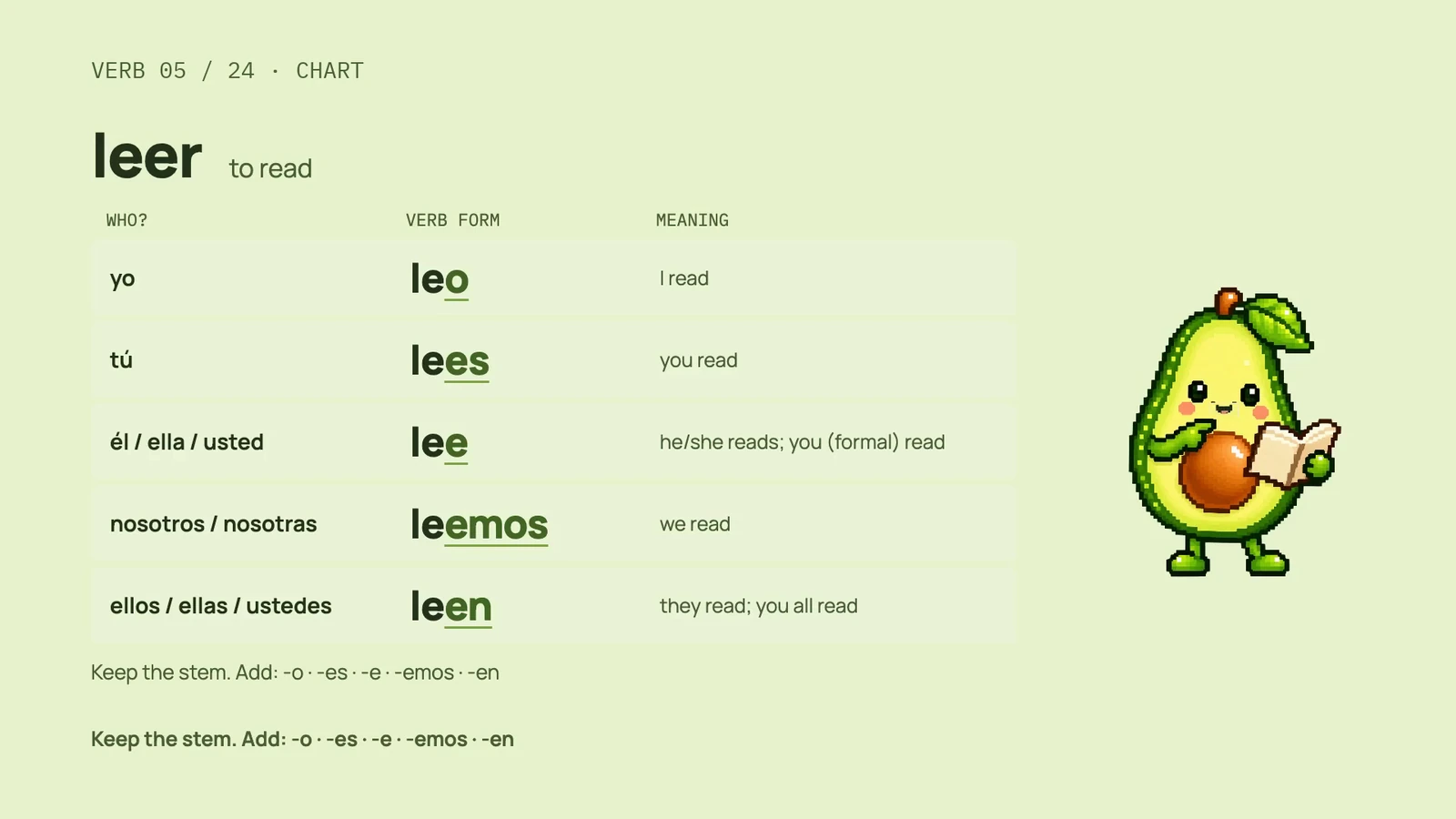
Avo’s tip: Keep the e in le- when you add an ending: leo, lees, lee. Both e’s belong in lee; listen to Avo’s Spanish model.
Yo leo un libro.
I read a book.
Read the five leer forms as text
| Who? | Verb | Meaning |
|---|---|---|
| yo | leo | I read |
| tú | lees | you read |
| él / ella / usted | lee | he/she reads; you (formal) read |
| nosotros / nosotras | leemos | we read |
| ellos / ellas / ustedes | leen | they read; you all read |
6. vivir — to live
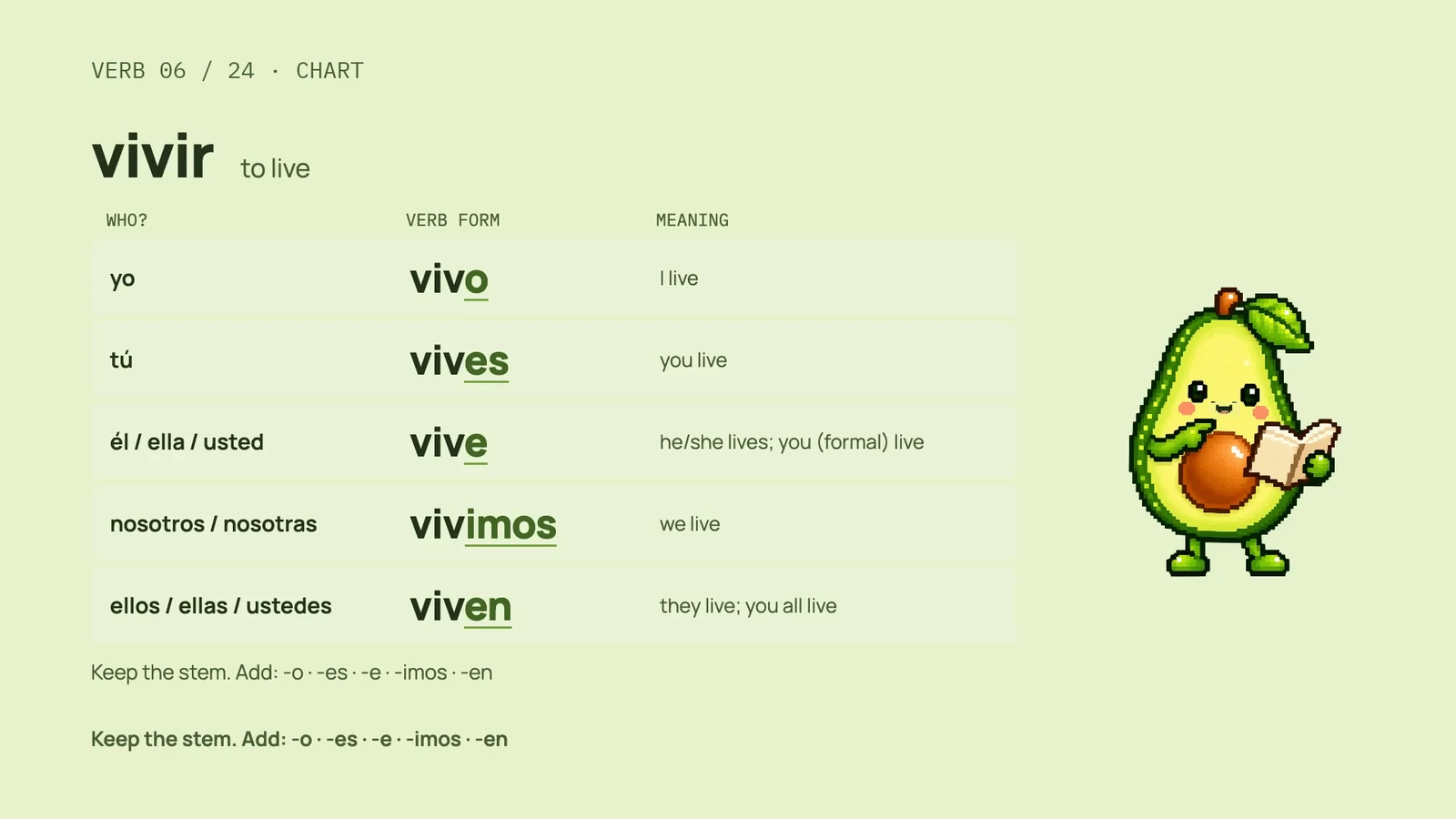
Avo’s tip: Regular -ir verbs share most of these -er endings. The we form changes to -imos: vivimos.
Yo vivo aquí.
I live here.
Read the five vivir forms as text
| Who? | Verb | Meaning |
|---|---|---|
| yo | vivo | I live |
| tú | vives | you live |
| él / ella / usted | vive | he/she lives; you (formal) live |
| nosotros / nosotras | vivimos | we live |
| ellos / ellas / ustedes | viven | they live; you all live |
7. abrir — to open
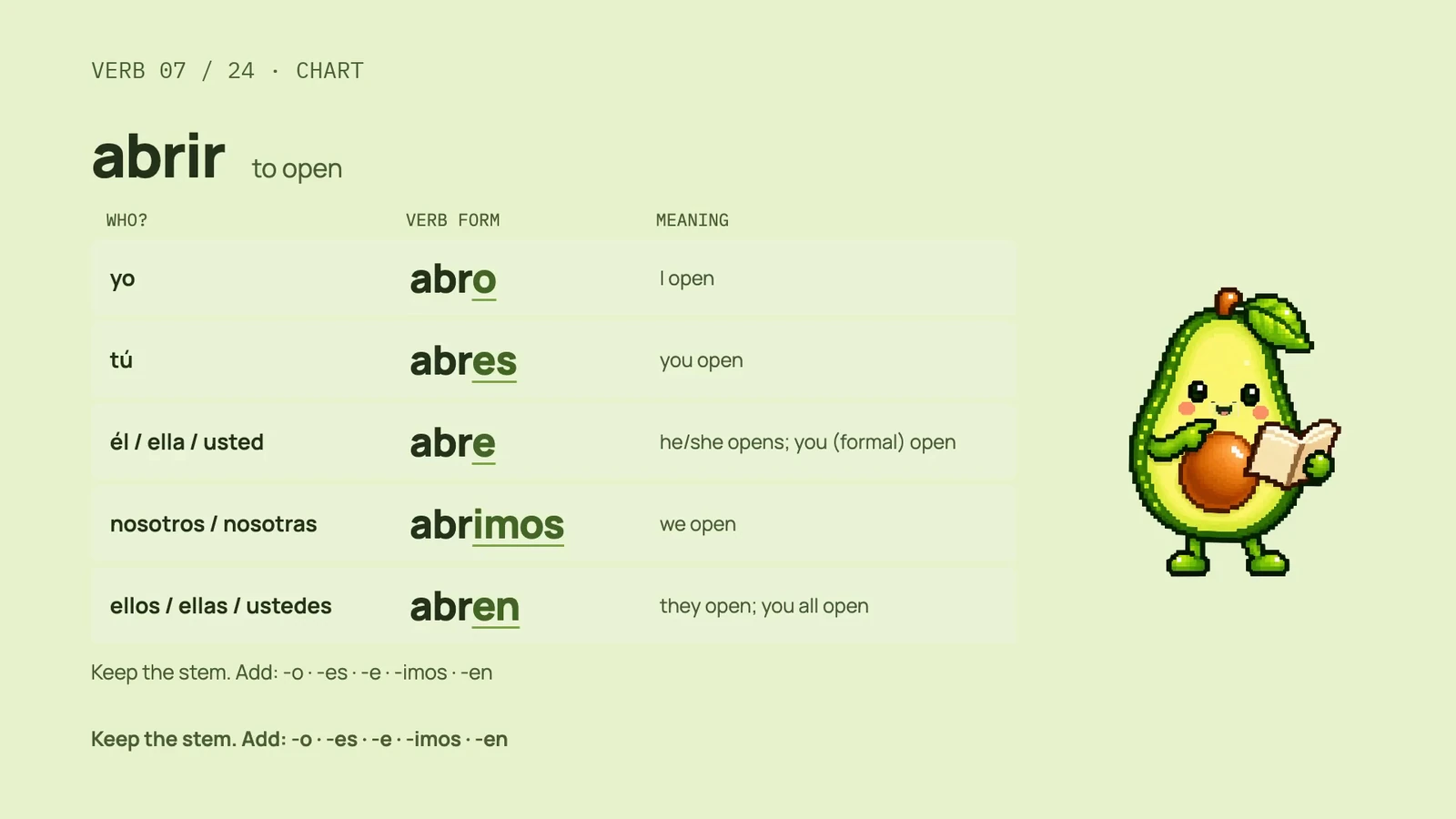
Avo’s tip: Keep abr- and use the same endings as vivir. Abrimos means “we open”; abren means “they open” or “you all open.”
Yo abro la puerta.
I open the door.
Read the five abrir forms as text
| Who? | Verb | Meaning |
|---|---|---|
| yo | abro | I open |
| tú | abres | you open |
| él / ella / usted | abre | he/she opens; you (formal) open |
| nosotros / nosotras | abrimos | we open |
| ellos / ellas / ustedes | abren | they open; you all open |
8–10: Learn ser, estar and ir as small sets
8. ser — to be
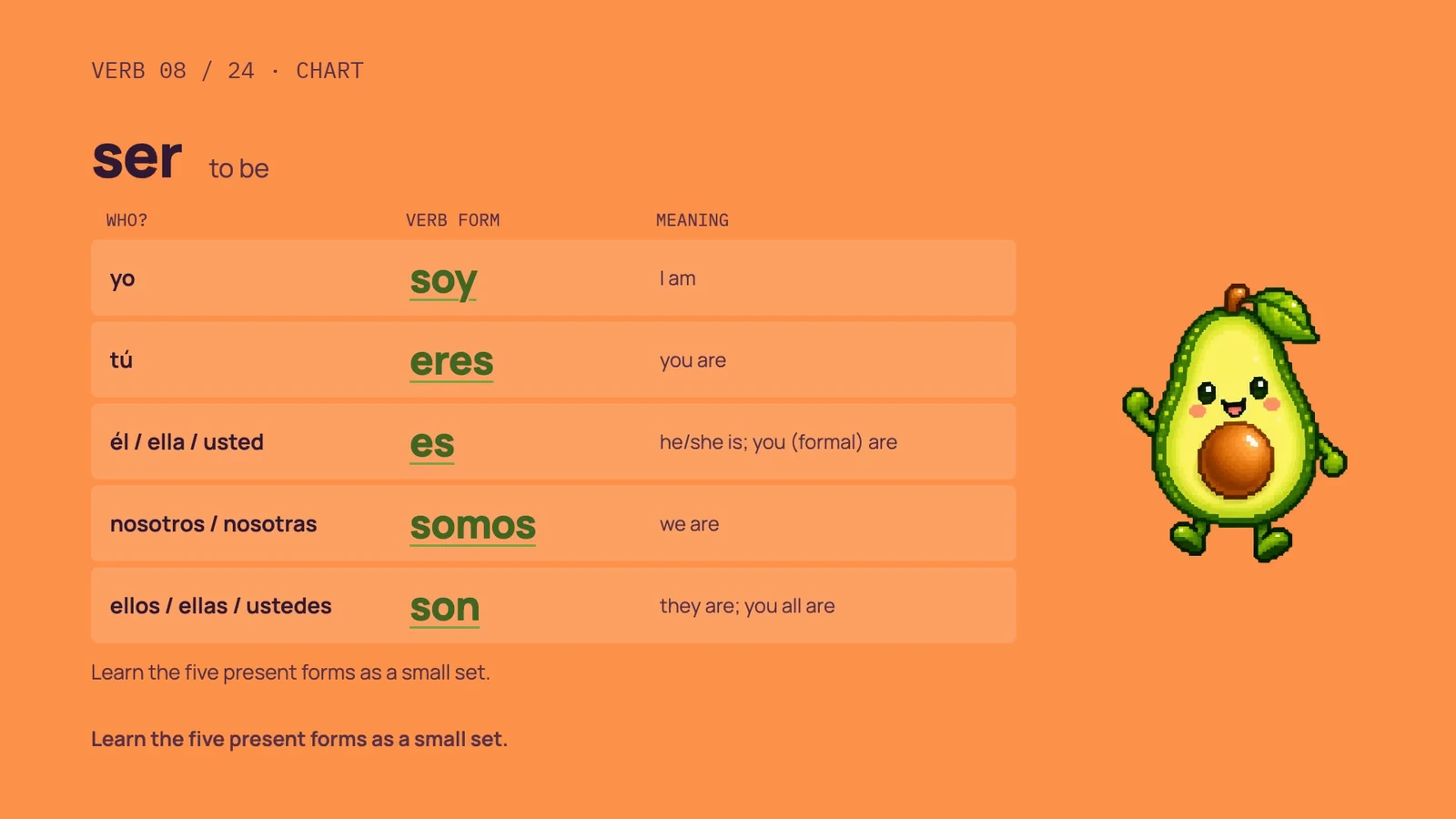
Avo’s tip: Learn soy, eres, es, somos and son as a set. Ser identifies people and relationships here; “permanent” is not a complete rule.
Yo soy tu amigo.
I am your friend.
Read the five ser forms as text
| Who? | Verb | Meaning |
|---|---|---|
| yo | soy | I am |
| tú | eres | you are |
| él / ella / usted | es | he/she is; you (formal) are |
| nosotros / nosotras | somos | we are |
| ellos / ellas / ustedes | son | they are; you all are |
9. estar — to be
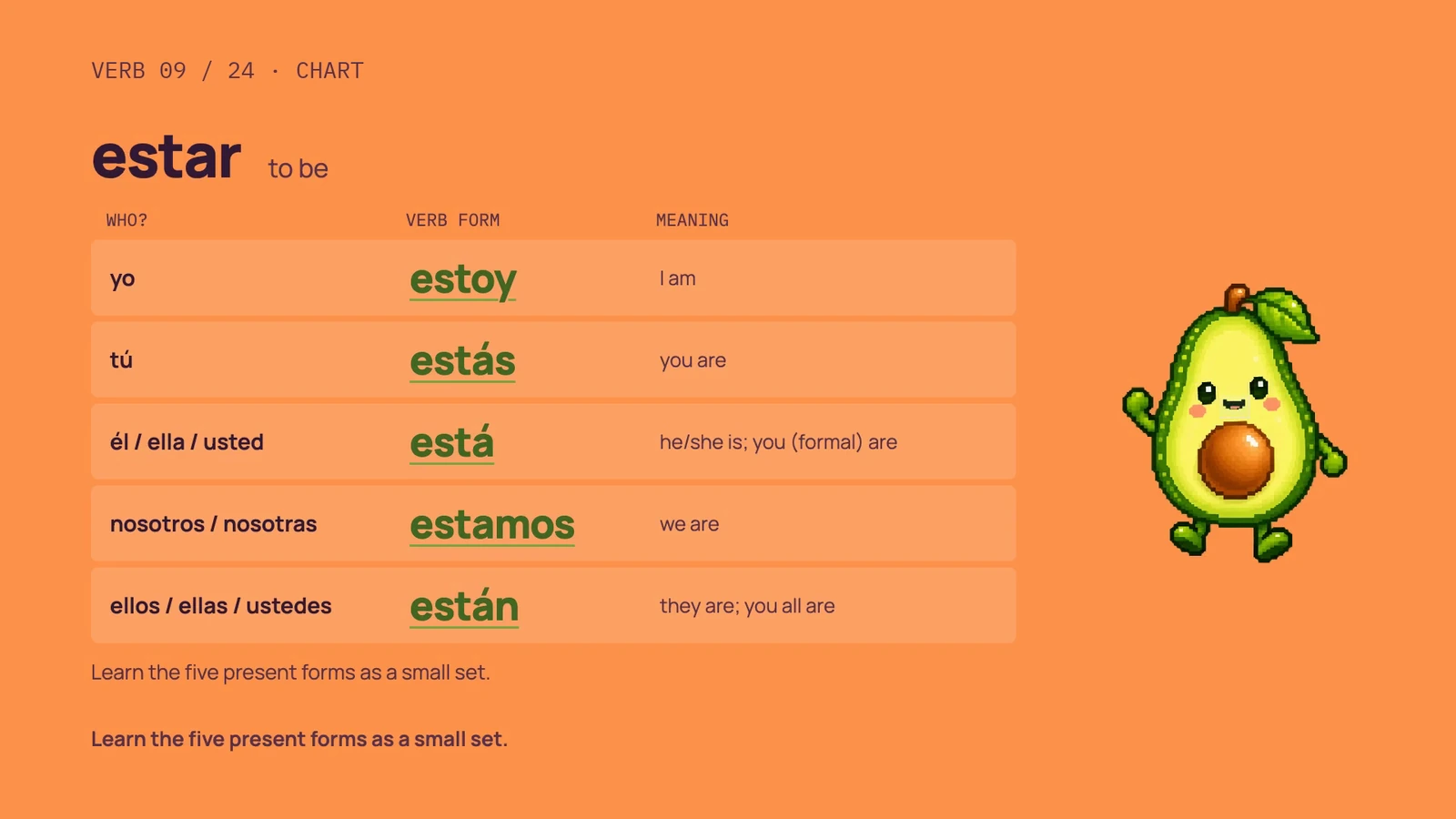
Avo’s tip: Use estar for location and how someone feels in these examples. Keep the accents in estás, está and están; estamos has none.
Yo estoy aquí.
I am here.
Read the five estar forms as text
| Who? | Verb | Meaning |
|---|---|---|
| yo | estoy | I am |
| tú | estás | you are |
| él / ella / usted | está | he/she is; you (formal) are |
| nosotros / nosotras | estamos | we are |
| ellos / ellas / ustedes | están | they are; you all are |
10. ir — to go
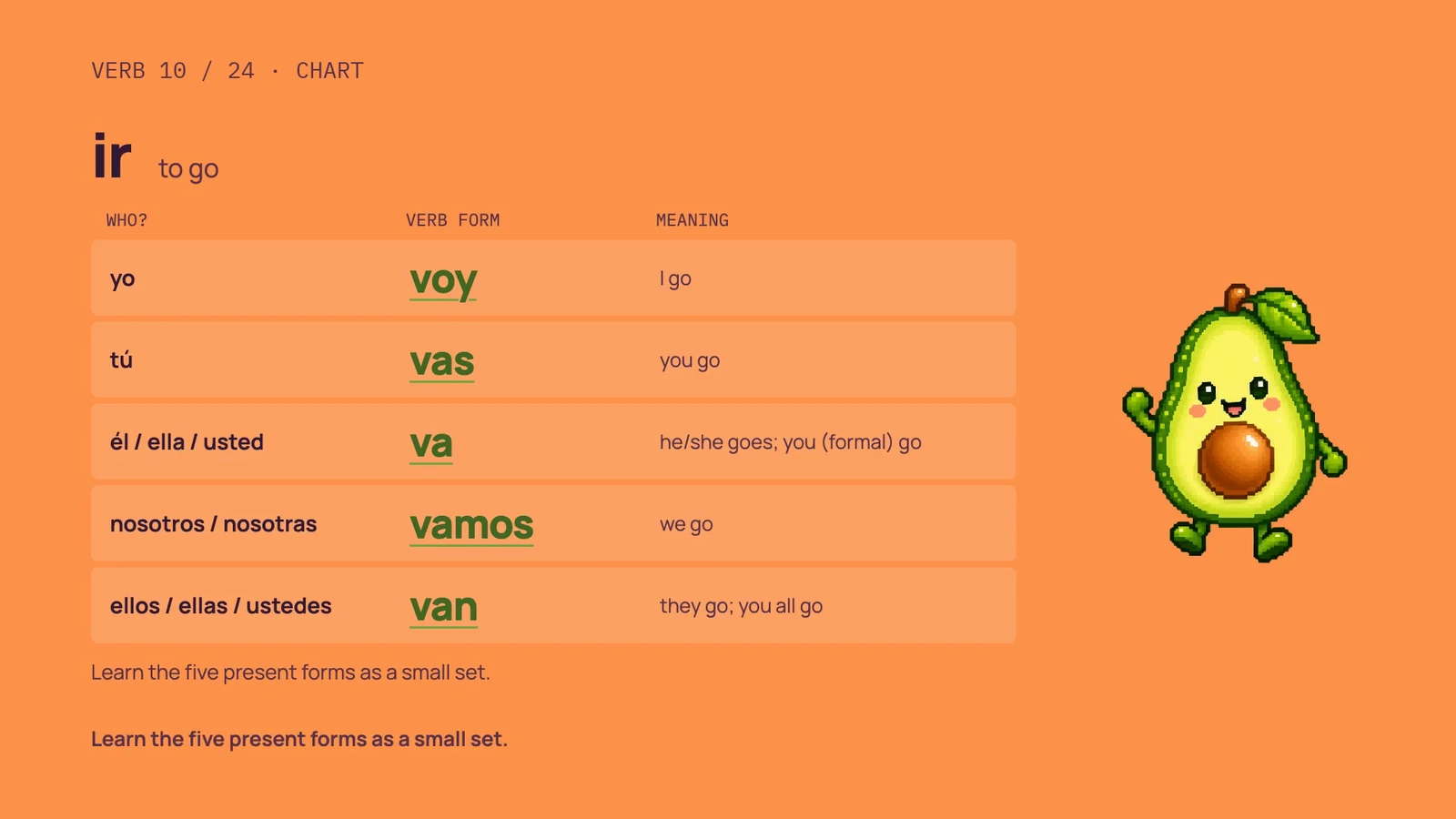
Avo’s tip: Learn voy, vas, va, vamos and van together. Voy a casa means “I’m going home.” These forms come from ir.
Yo voy a casa.
I am going home.
Read the five ir forms as text
| Who? | Verb | Meaning |
|---|---|---|
| yo | voy | I go |
| tú | vas | you go |
| él / ella / usted | va | he/she goes; you (formal) go |
| nosotros / nosotras | vamos | we go |
| ellos / ellas / ustedes | van | they go; you all go |
11–17: Notice the special yo form
11. hacer — to do; to make
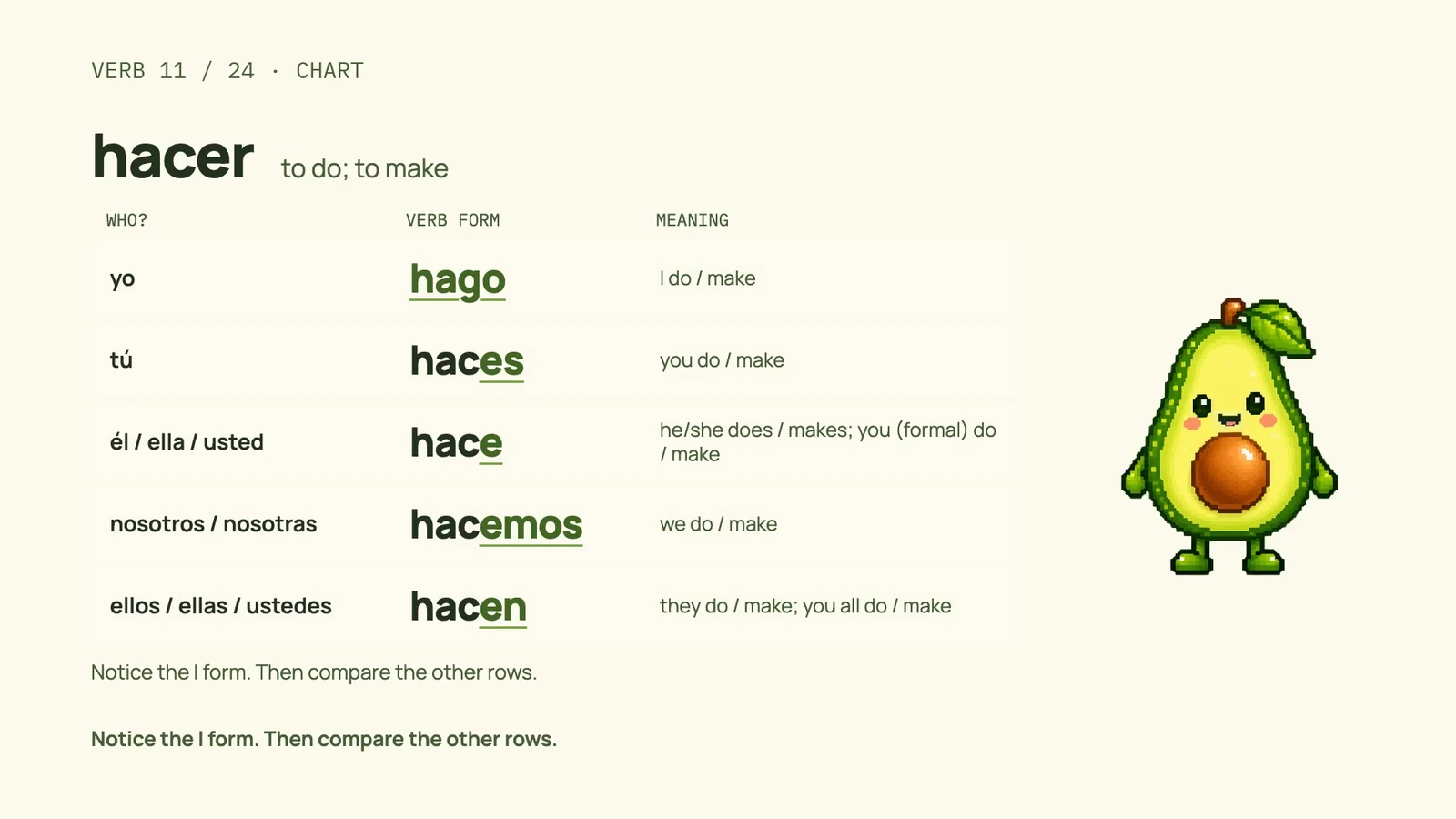
Avo’s tip: Give the I row special attention: hago. The other rows keep hac-: haces, hace, hacemos, hacen. Hacer can mean do or make.
Yo hago la comida.
I make the food.
Read the five hacer forms as text
| Who? | Verb | Meaning |
|---|---|---|
| yo | hago | I do / make |
| tú | haces | you do / make |
| él / ella / usted | hace | he/she does / makes; you (formal) do / make |
| nosotros / nosotras | hacemos | we do / make |
| ellos / ellas / ustedes | hacen | they do / make; you all do / make |
12. poner — to put; to set
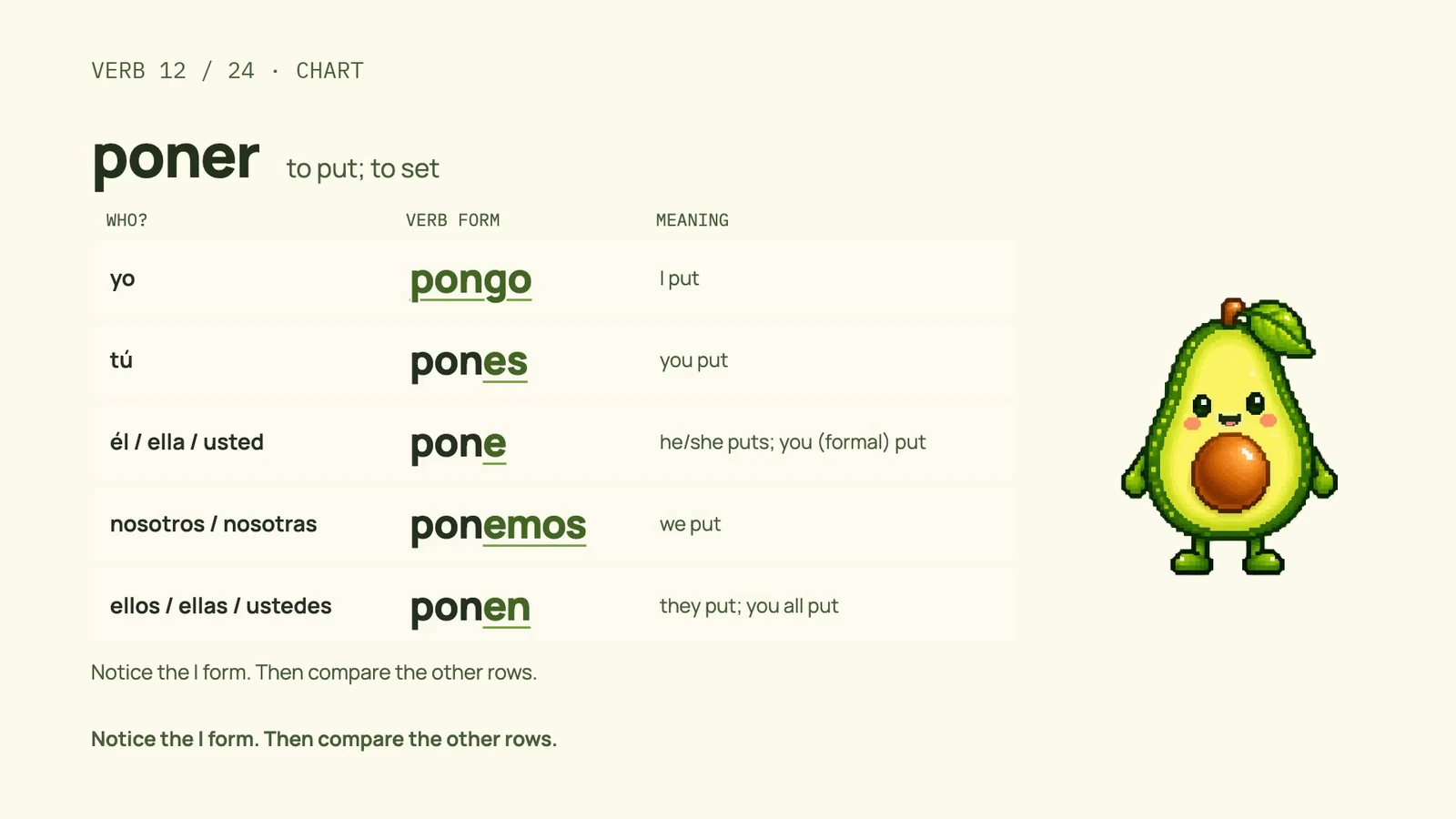
Avo’s tip: The I form is pongo, with an extra g. The other rows keep pon-. Poner la mesa is the useful phrase “set the table.”
Yo pongo el libro aquí.
I put the book here.
Read the five poner forms as text
| Who? | Verb | Meaning |
|---|---|---|
| yo | pongo | I put |
| tú | pones | you put |
| él / ella / usted | pone | he/she puts; you (formal) put |
| nosotros / nosotras | ponemos | we put |
| ellos / ellas / ustedes | ponen | they put; you all put |
13. salir — to leave; to go out
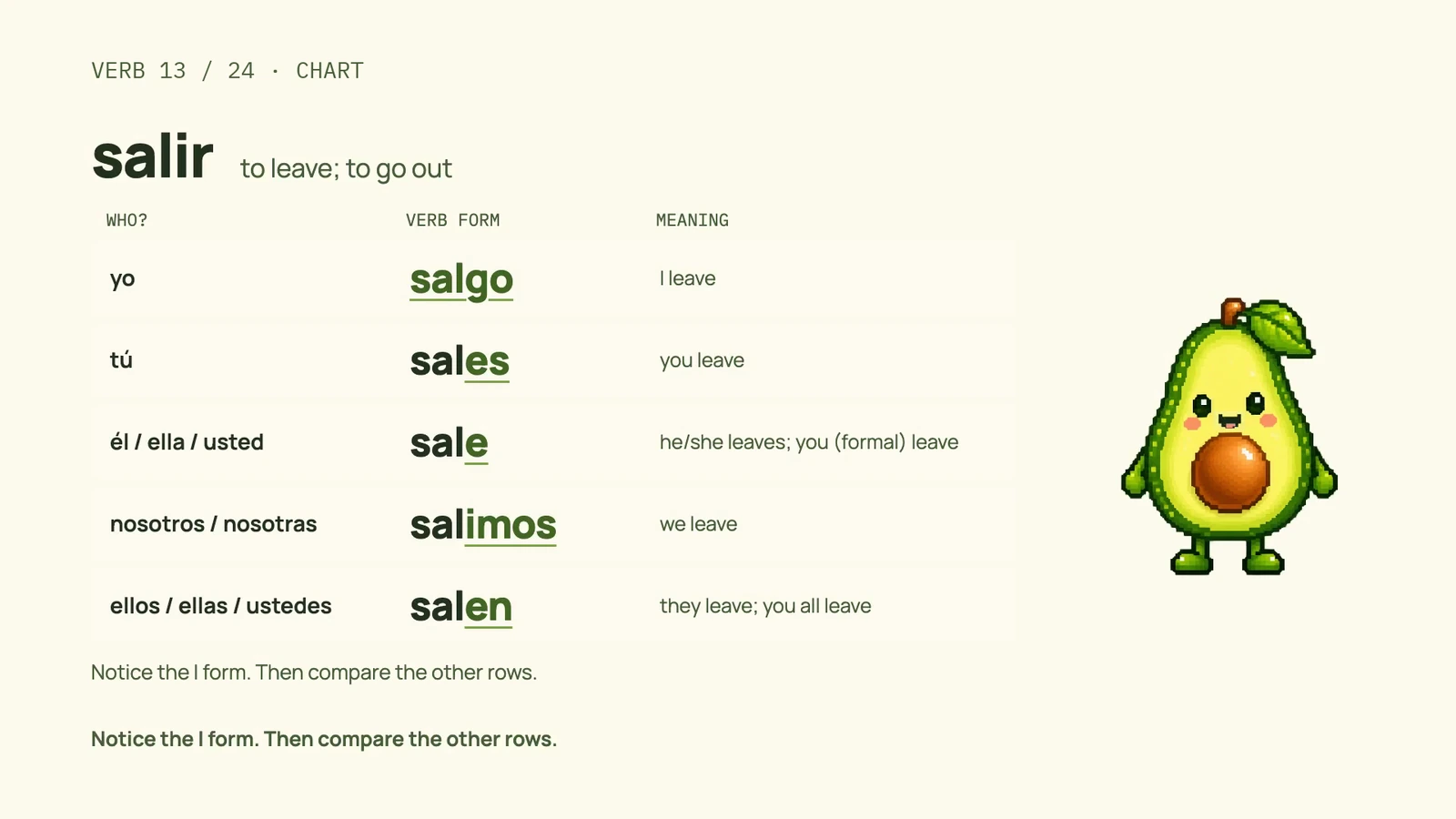
Avo’s tip: Another special I form: salgo. The we row uses the -ir ending: salimos. Use salir for leaving or going out.
Yo salgo de casa.
I leave home.
Read the five salir forms as text
| Who? | Verb | Meaning |
|---|---|---|
| yo | salgo | I leave |
| tú | sales | you leave |
| él / ella / usted | sale | he/she leaves; you (formal) leave |
| nosotros / nosotras | salimos | we leave |
| ellos / ellas / ustedes | salen | they leave; you all leave |
14. dar — to give
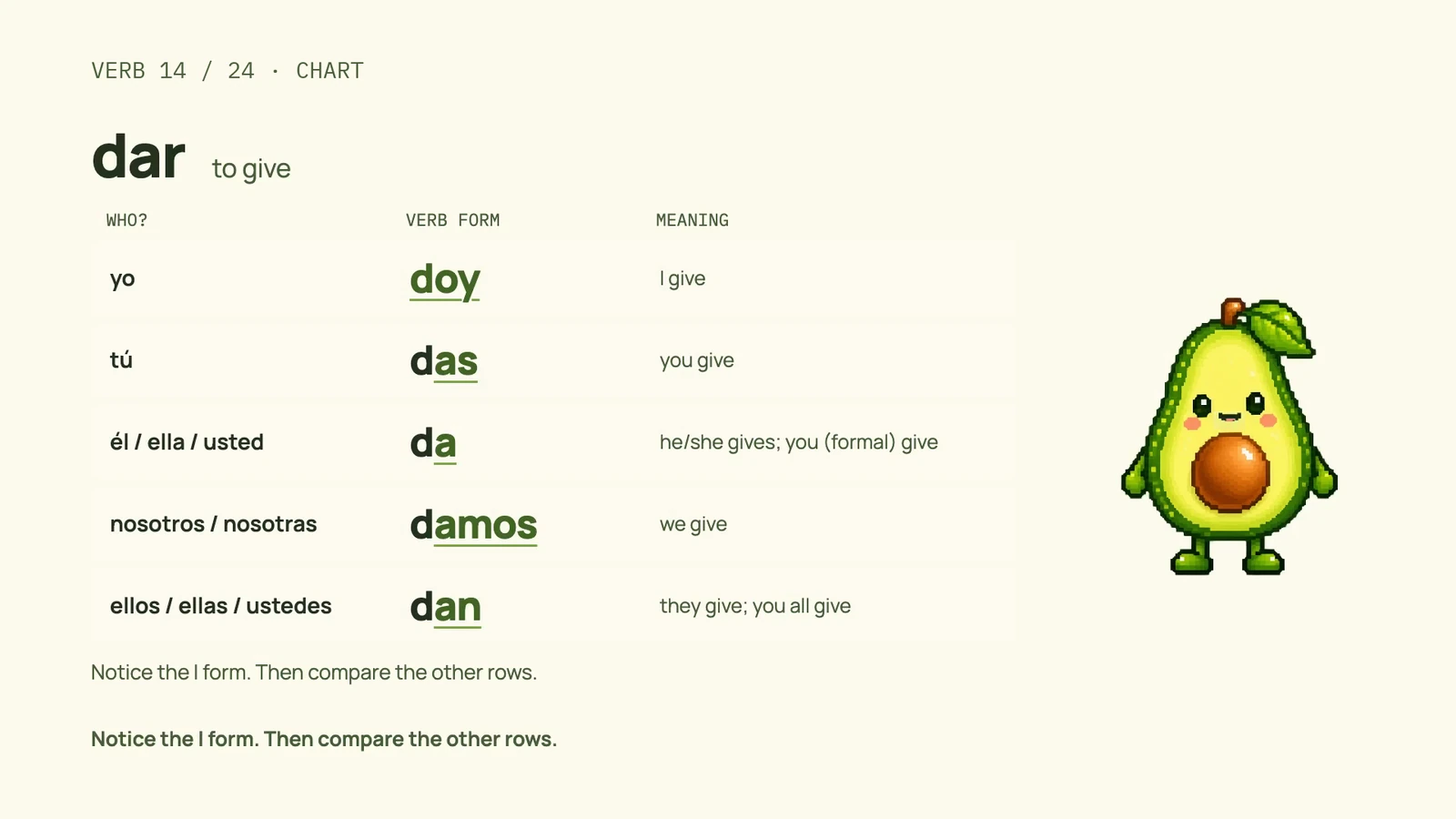
Avo’s tip: Remember doy in the I row. None of these five present forms needs a written accent. Te doy means “I give you.”
Yo te doy agua.
I give you water.
Read the five dar forms as text
| Who? | Verb | Meaning |
|---|---|---|
| yo | doy | I give |
| tú | das | you give |
| él / ella / usted | da | he/she gives; you (formal) give |
| nosotros / nosotras | damos | we give |
| ellos / ellas / ustedes | dan | they give; you all give |
15. ver — to see; to watch
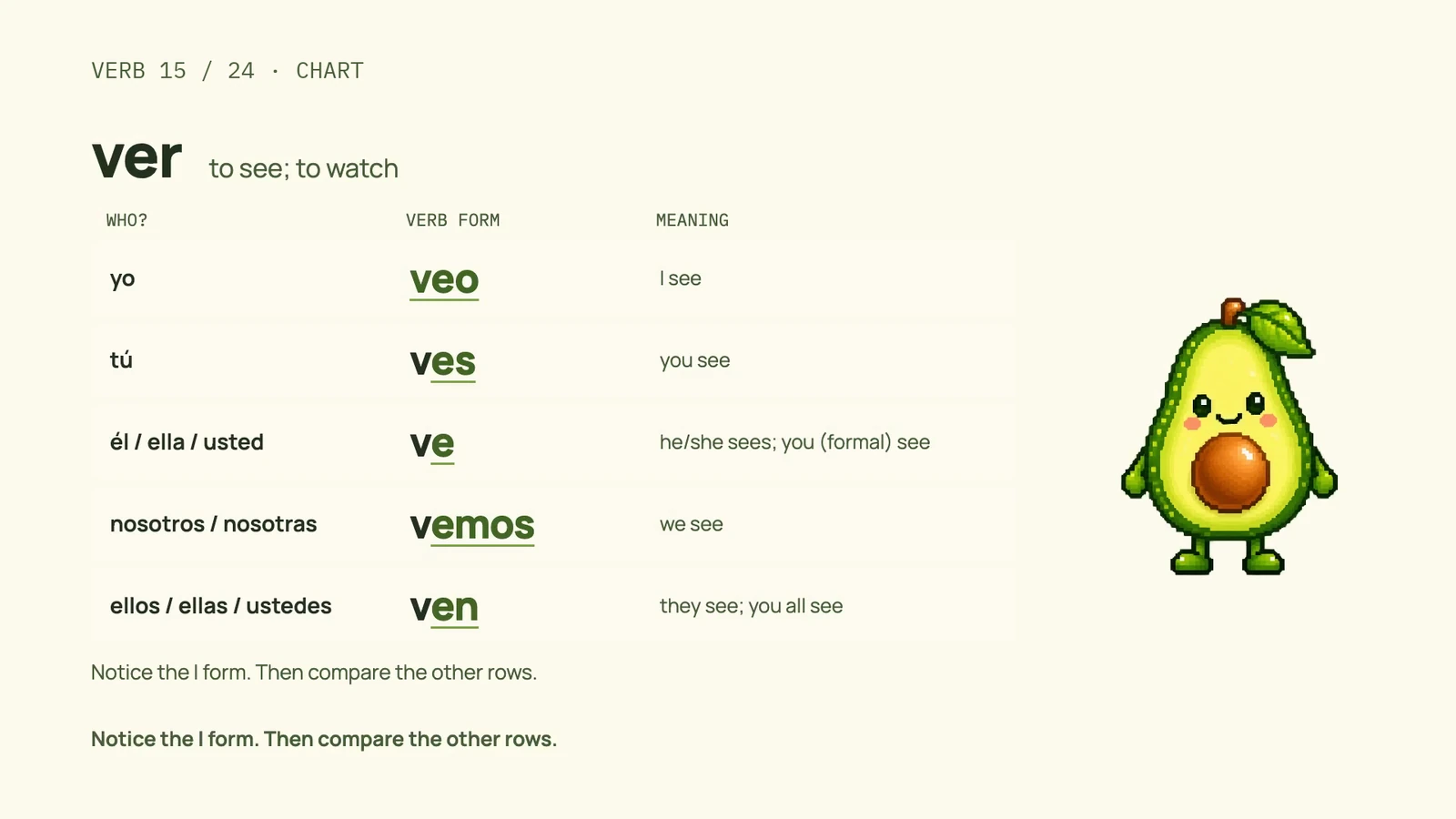
Avo’s tip: The I form is veo; the other forms are short: ves, ve, vemos, ven. Ver can mean see or watch, depending on the sentence.
Yo veo a mi familia.
I see my family.
Read the five ver forms as text
| Who? | Verb | Meaning |
|---|---|---|
| yo | veo | I see |
| tú | ves | you see |
| él / ella / usted | ve | he/she sees; you (formal) see |
| nosotros / nosotras | vemos | we see |
| ellos / ellas / ustedes | ven | they see; you all see |
16. saber — to know
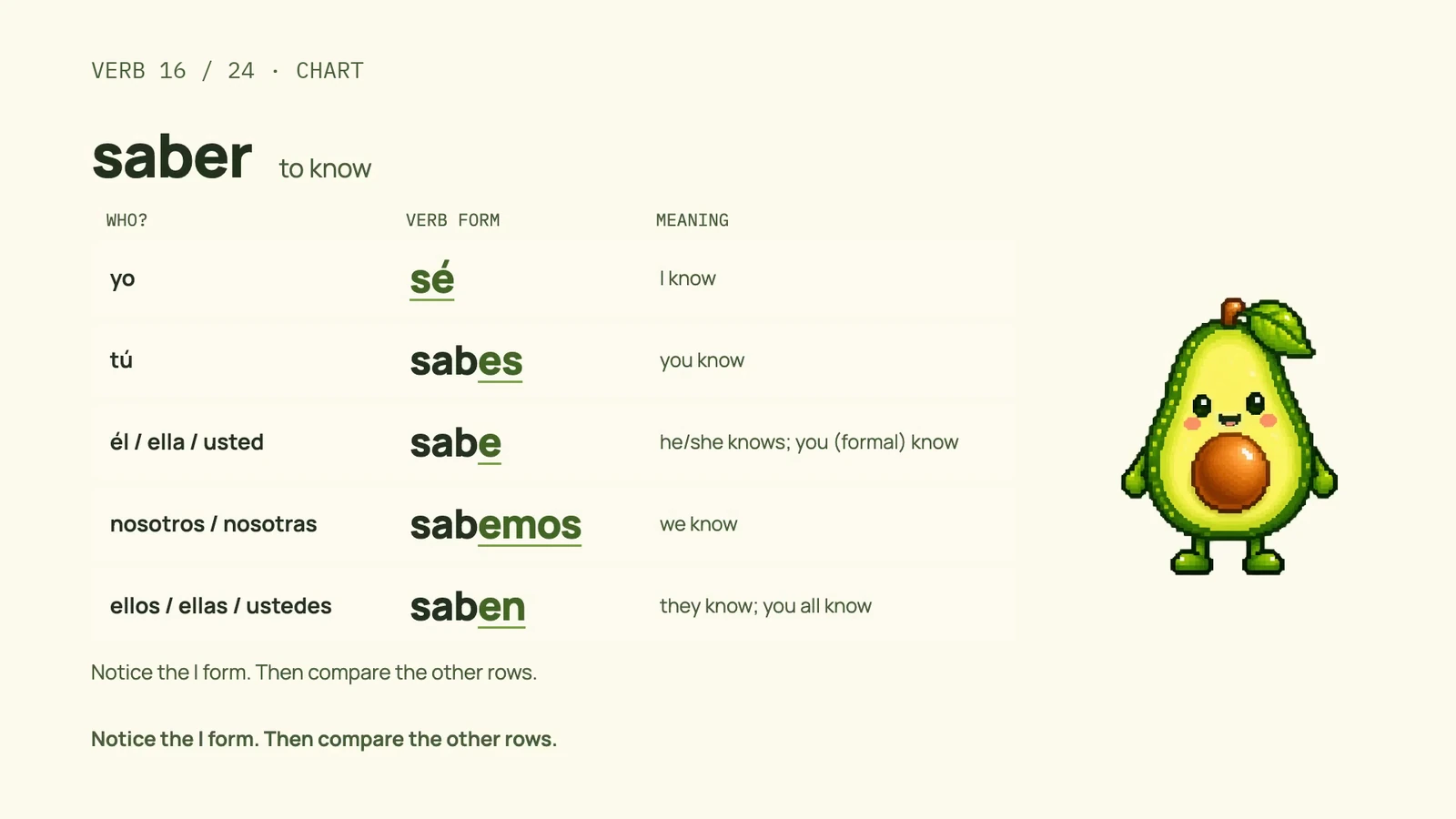
Avo’s tip: Learn yo sé, including its accent. Use saber for knowing information or knowing how to do something: sé + basic verb.
Yo sé la respuesta.
I know the answer.
Read the five saber forms as text
| Who? | Verb | Meaning |
|---|---|---|
| yo | sé | I know |
| tú | sabes | you know |
| él / ella / usted | sabe | he/she knows; you (formal) know |
| nosotros / nosotras | sabemos | we know |
| ellos / ellas / ustedes | saben | they know; you all know |
17. conocer — to know; to be familiar with
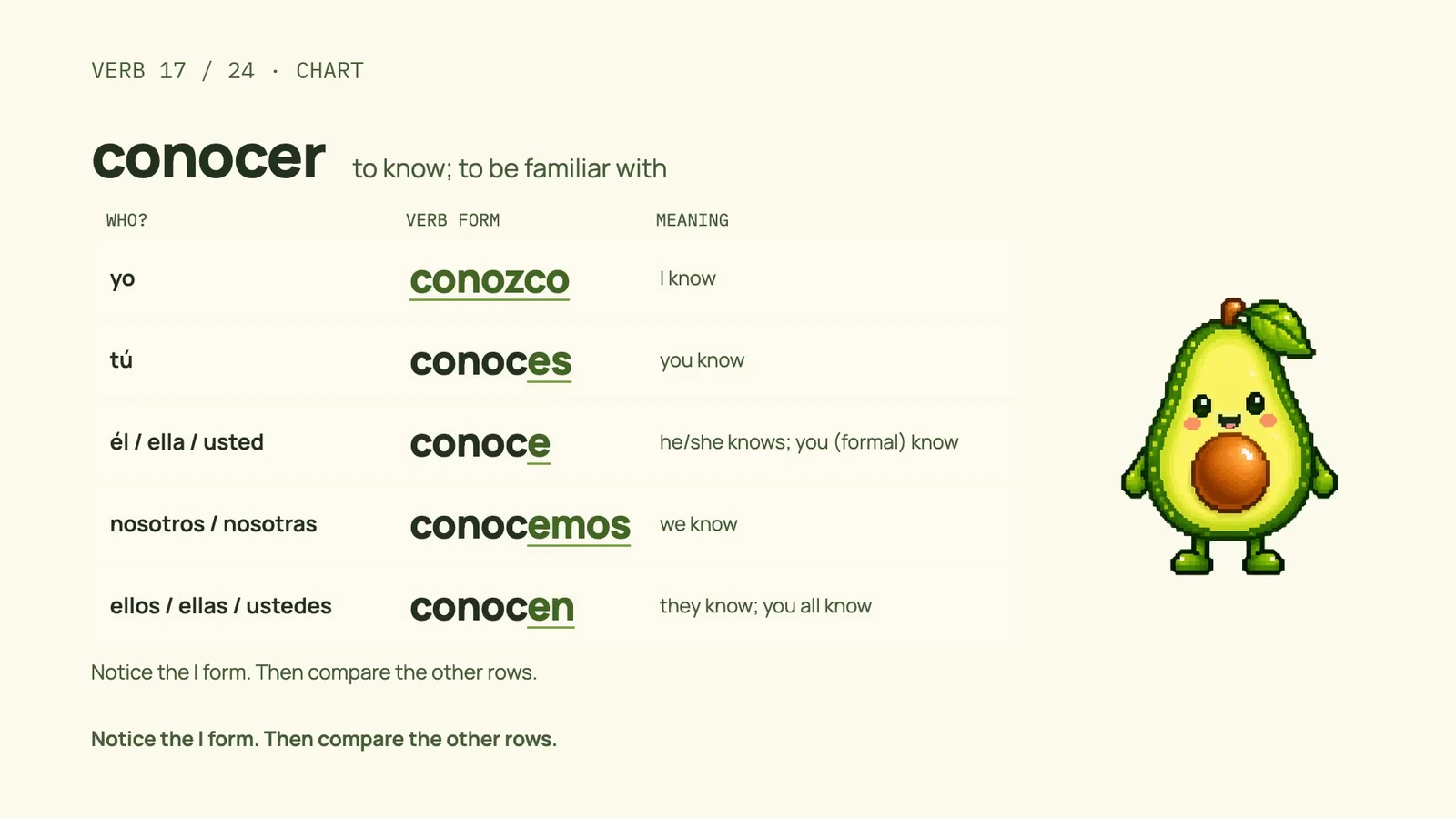
Avo’s tip: Notice conozco in the I row. Use conocer for knowing people or being familiar with places; saber covers information and know-how.
Yo conozco a tu familia.
I know your family.
Read the five conocer forms as text
| Who? | Verb | Meaning |
|---|---|---|
| yo | conozco | I know |
| tú | conoces | you know |
| él / ella / usted | conoce | he/she knows; you (formal) know |
| nosotros / nosotras | conocemos | we know |
| ellos / ellas / ustedes | conocen | they know; you all know |
18–21: The vowel changes; the we row stays
18. poder — to be able to; can
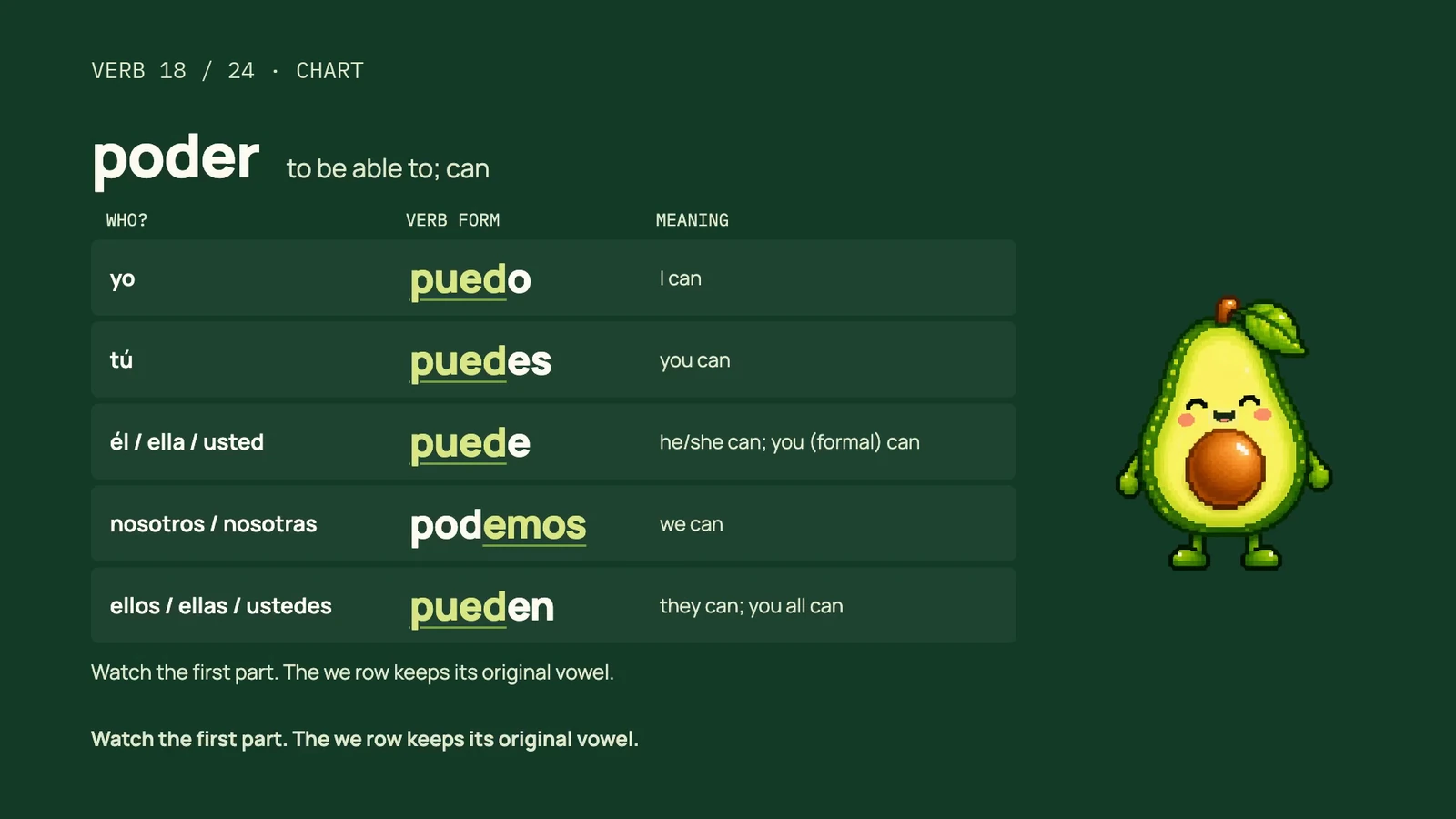
Avo’s tip: The o changes to ue in four rows: puedo, puedes, puede, pueden. The we row keeps o: podemos. Add a basic verb: puedo ir.
Yo puedo ir.
I can go.
Read the five poder forms as text
| Who? | Verb | Meaning |
|---|---|---|
| yo | puedo | I can |
| tú | puedes | you can |
| él / ella / usted | puede | he/she can; you (formal) can |
| nosotros / nosotras | podemos | we can |
| ellos / ellas / ustedes | pueden | they can; you all can |
19. querer — to want
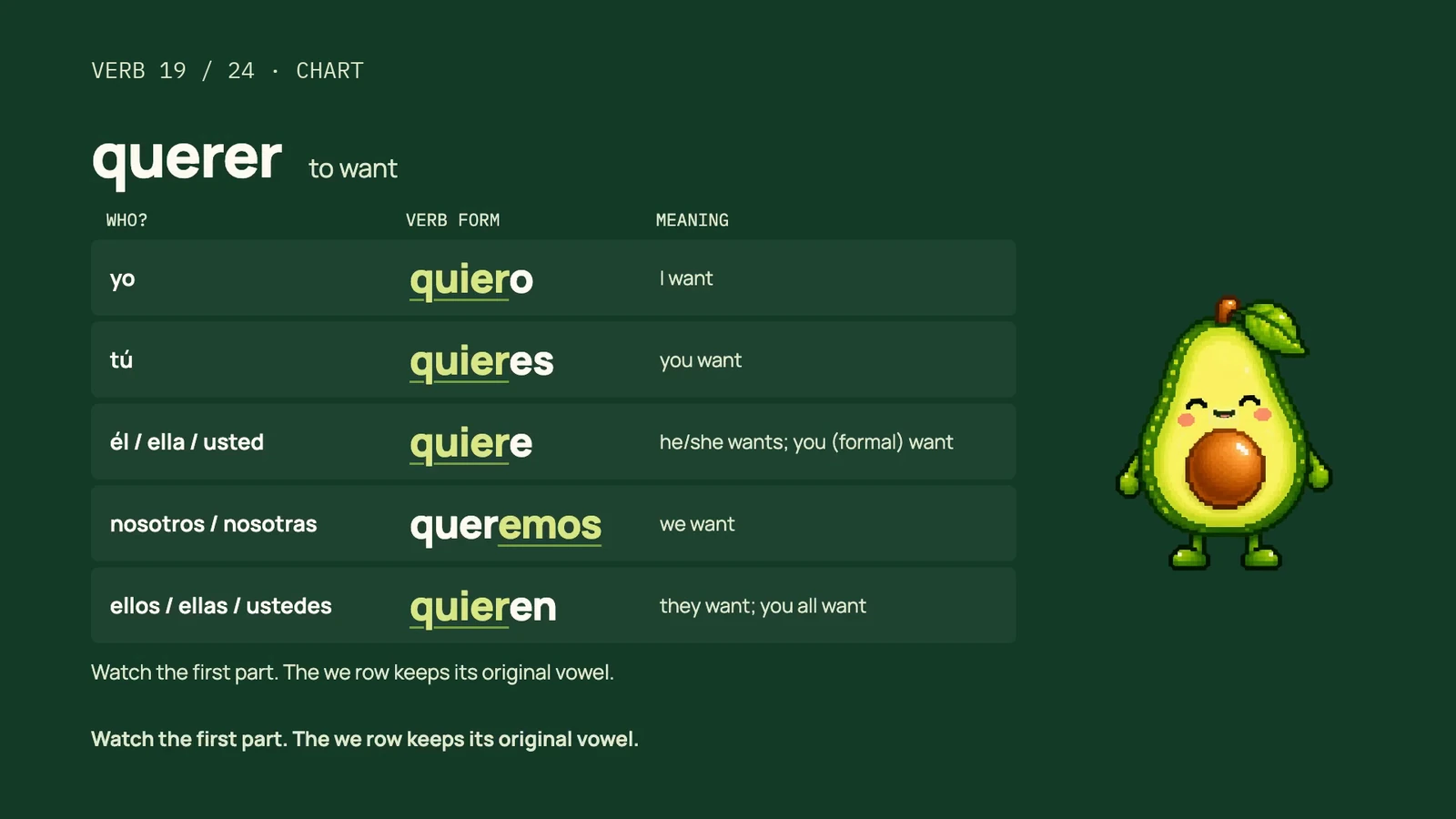
Avo’s tip: The e changes to ie, but the we row keeps e: queremos. Follow querer with a thing or a basic verb: quiero agua, quiero ir.
Yo quiero agua.
I want water.
Read the five querer forms as text
| Who? | Verb | Meaning |
|---|---|---|
| yo | quiero | I want |
| tú | quieres | you want |
| él / ella / usted | quiere | he/she wants; you (formal) want |
| nosotros / nosotras | queremos | we want |
| ellos / ellas / ustedes | quieren | they want; you all want |
20. pedir — to ask for; to order
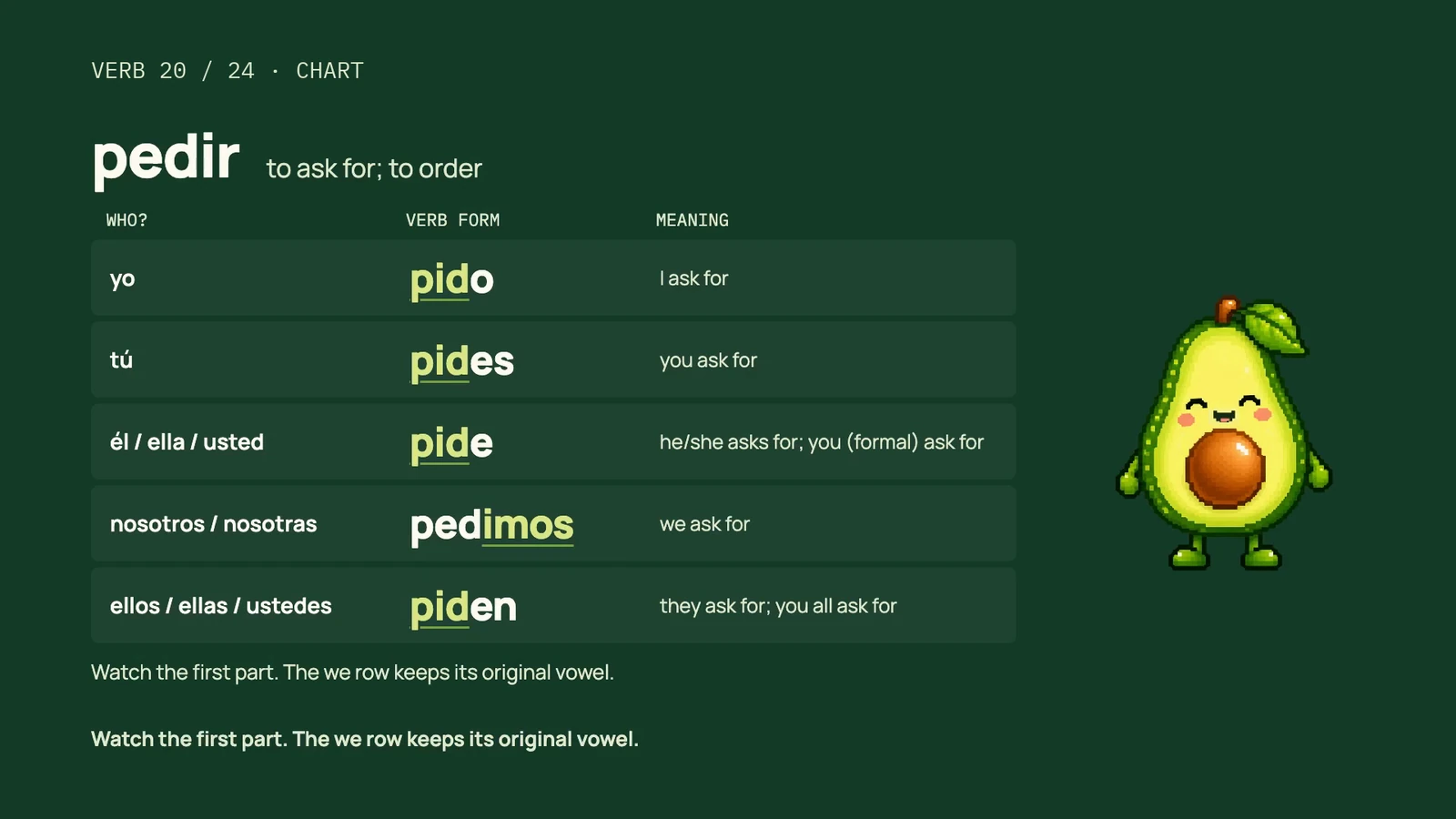
Avo’s tip: The e changes to i: pido, pides, pide, piden. Keep e in pedimos. Pedir asks for something; preguntar asks a question.
Yo pido ayuda.
I ask for help.
Read the five pedir forms as text
| Who? | Verb | Meaning |
|---|---|---|
| yo | pido | I ask for |
| tú | pides | you ask for |
| él / ella / usted | pide | he/she asks for; you (formal) ask for |
| nosotros / nosotras | pedimos | we ask for |
| ellos / ellas / ustedes | piden | they ask for; you all ask for |
21. dormir — to sleep
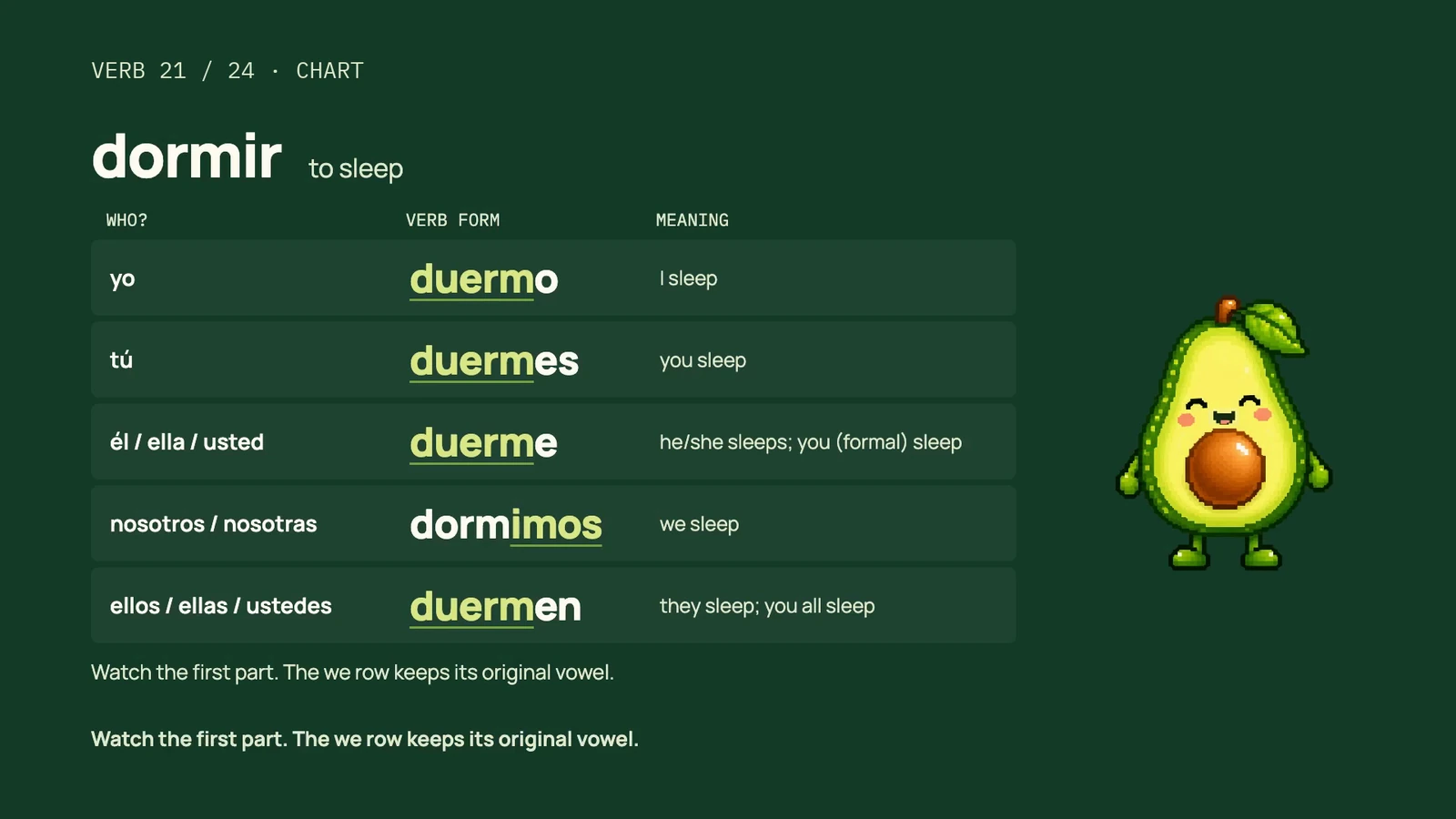
Avo’s tip: Change o to ue in four rows, but keep dorm- in dormimos. The -imos ending is your clue that this is an -ir verb.
Yo duermo bien.
I sleep well.
Read the five dormir forms as text
| Who? | Verb | Meaning |
|---|---|---|
| yo | duermo | I sleep |
| tú | duermes | you sleep |
| él / ella / usted | duerme | he/she sleeps; you (formal) sleep |
| nosotros / nosotras | dormimos | we sleep |
| ellos / ellas / ustedes | duermen | they sleep; you all sleep |
22–24: Put two changes together
22. tener — to have
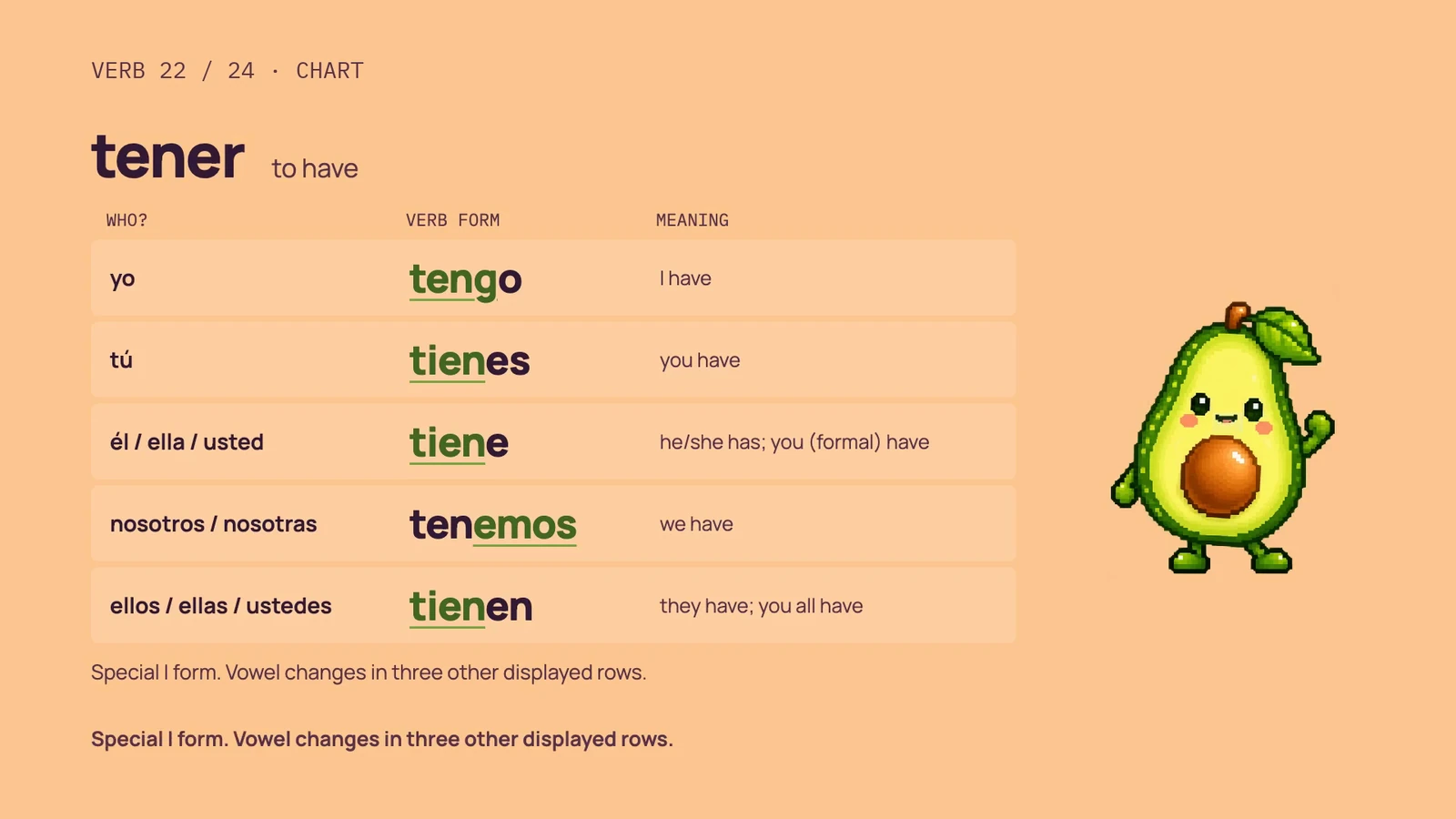
Avo’s tip: Two patterns work together: tengo is special, and tienes, tiene, tienen change e to ie. Tenemos keeps the original vowel.
Yo tengo tiempo.
I have time.
Read the five tener forms as text
| Who? | Verb | Meaning |
|---|---|---|
| yo | tengo | I have |
| tú | tienes | you have |
| él / ella / usted | tiene | he/she has; you (formal) have |
| nosotros / nosotras | tenemos | we have |
| ellos / ellas / ustedes | tienen | they have; you all have |
23. venir — to come
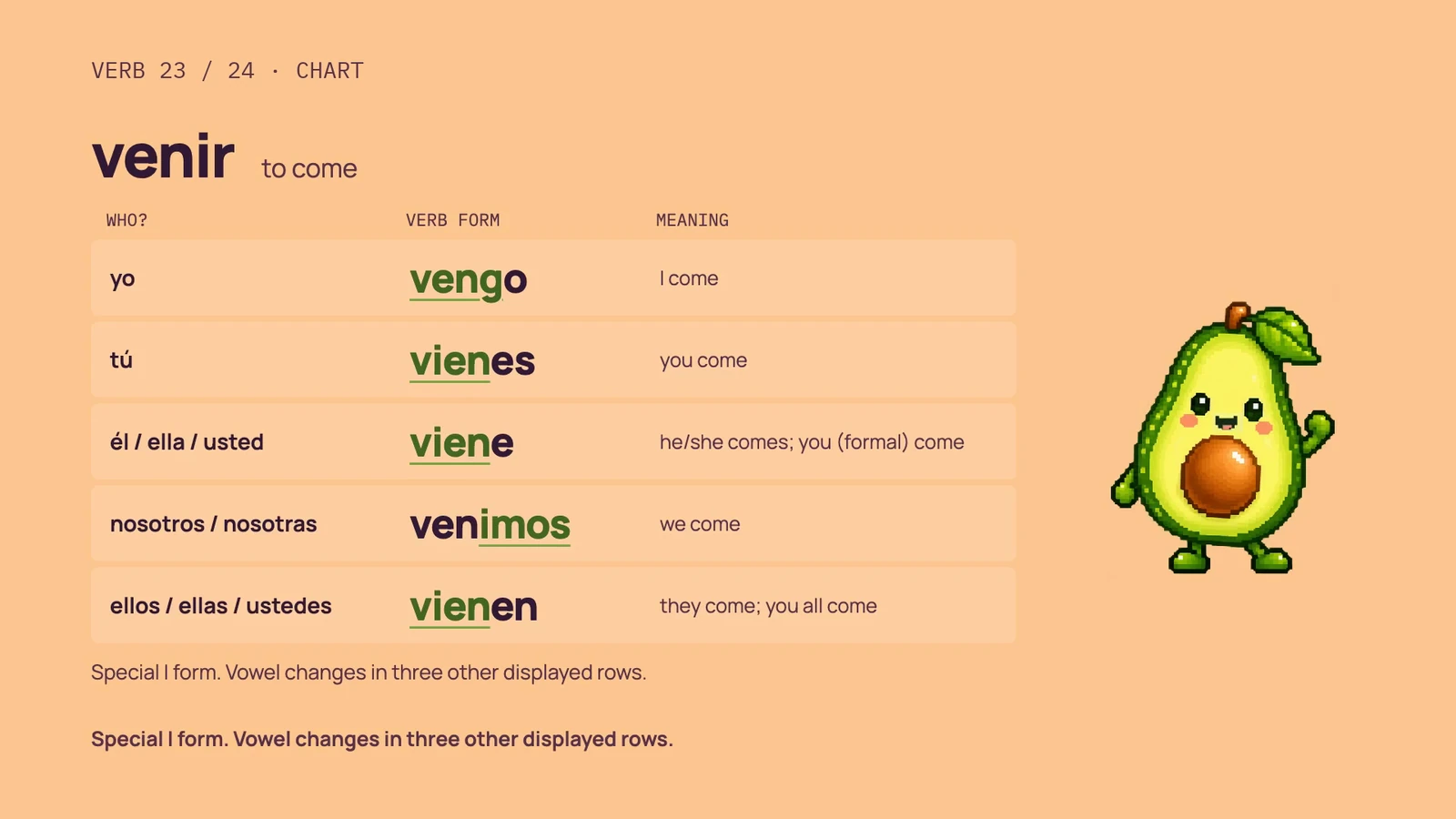
Avo’s tip: Remember vengo, then vienes, viene and vienen. The we form is venimos. Venir describes coming toward “here” or a chosen viewpoint.
Yo vengo de casa.
I am coming from home.
Read the five venir forms as text
| Who? | Verb | Meaning |
|---|---|---|
| yo | vengo | I come |
| tú | vienes | you come |
| él / ella / usted | viene | he/she comes; you (formal) come |
| nosotros / nosotras | venimos | we come |
| ellos / ellas / ustedes | vienen | they come; you all come |
24. decir — to say; to tell
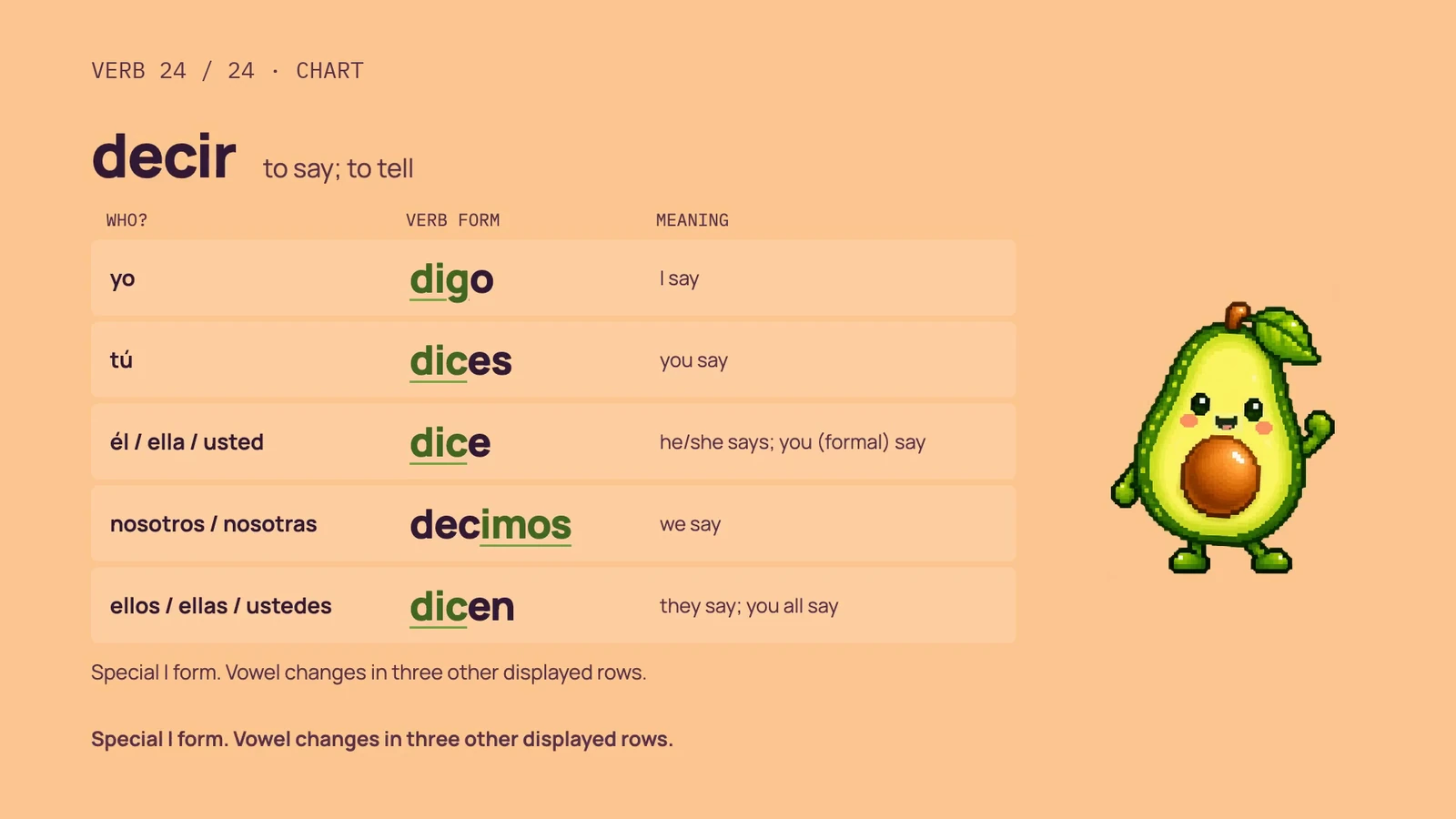
Avo’s tip: Learn digo first. Dices, dice and dicen change e to i; decimos keeps e. Decir can mean say or tell.
Yo digo la verdad.
I tell the truth.
Read the five decir forms as text
| Who? | Verb | Meaning |
|---|---|---|
| yo | digo | I say |
| tú | dices | you say |
| él / ella / usted | dice | he/she says; you (formal) say |
| nosotros / nosotras | decimos | we say |
| ellos / ellas / ustedes | dicen | they say; you all say |
Make one chart part of your day
Choose a verb you need. Read its five forms, cover the middle column, and try each person aloud. Then say its example and change one detail to make it true for you. Tomorrow, try the same chart before looking.
Ready for another step? Use our Spanish verb conjugation guide, compare ser and estar, or learn saber versus conocer. Create a free LSFR account for daily practice, including hands-free Voice Mode.
Quick questions
Do I need to memorize all 24 charts today?
No. Start with hablar, trabajar and necesitar. They share a regular -ar pattern. Learn a few useful sentences, then move to another chapter.
Why do some forms change in the middle?
Some verbs change their stem, the part before the ending: poder becomes puedo. In these present-tense charts, the nosotros/nosotras row keeps the original stem vowel: podemos.
Are these every possible conjugation?
These are five subject groups in the present indicative. Other tenses and regional forms have their own patterns. The full lesson practices these same forms through examples and recall rounds.
Let’s make it click, together.
Ask a question, share an example, or tell us what helped.
A kind space to learn. Keep it helpful, keep it human.



Community notes