One English word can hide two different Spanish choices. Our new lesson, Ser vs Estar, Por vs Para & More: 25 Confusing Spanish Word Pairs, helps you hear what changes. Here is its complete set of comparisons, with Avo’s original lesson charts and a short explanation for each. Start with one pair you can use today.
Watch, pause, and make the difference click
The free lesson runs for about 1 hour and 26 minutes, with Spanish examples, English meanings, slower practice, and comparison charts. You can watch here without an LSFR account. Subscribe on YouTube to keep learning with Avo.
For the stills below, tap a chart to open it at full size. The key distinction and one example from each side also appear as readable text.
Watch the full 25-pair lesson with Avo
Hear the contrasts, study the comparison charts, and practice the Spanish examples aloud. Pause or choose a chapter whenever you need more time.
Pause, repeat, and try saying each example out loud. Watch on YouTube ↗
1–5: Identity, purpose, knowledge, and requests
1. ser vs. estar
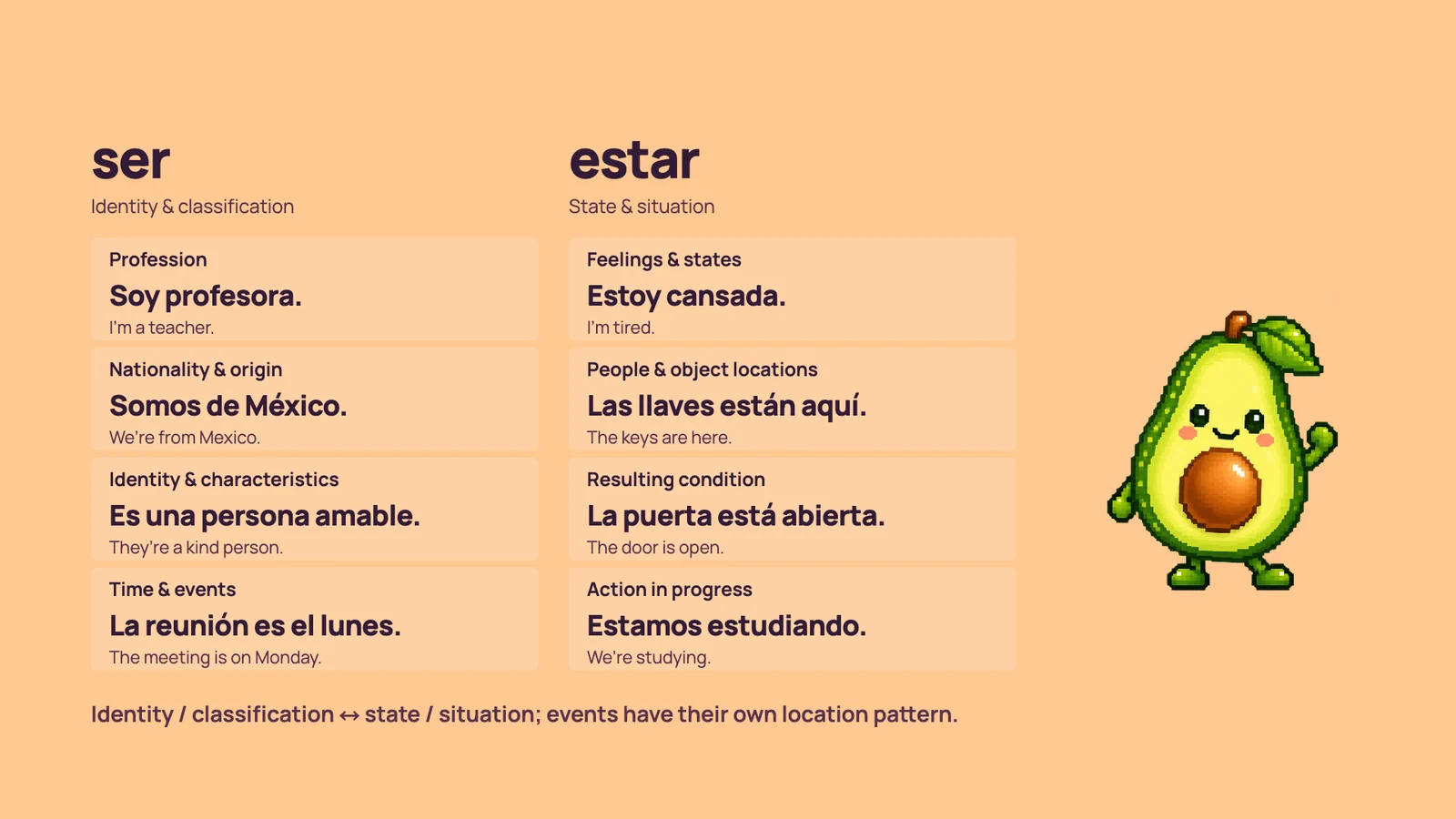
Ser identifies or classifies; estar describes a state or situation. Duration alone does not decide. People and objects use estar for location, while events use ser for where they take place.
I’m a teacher.
I’m tired.
2. por vs. para
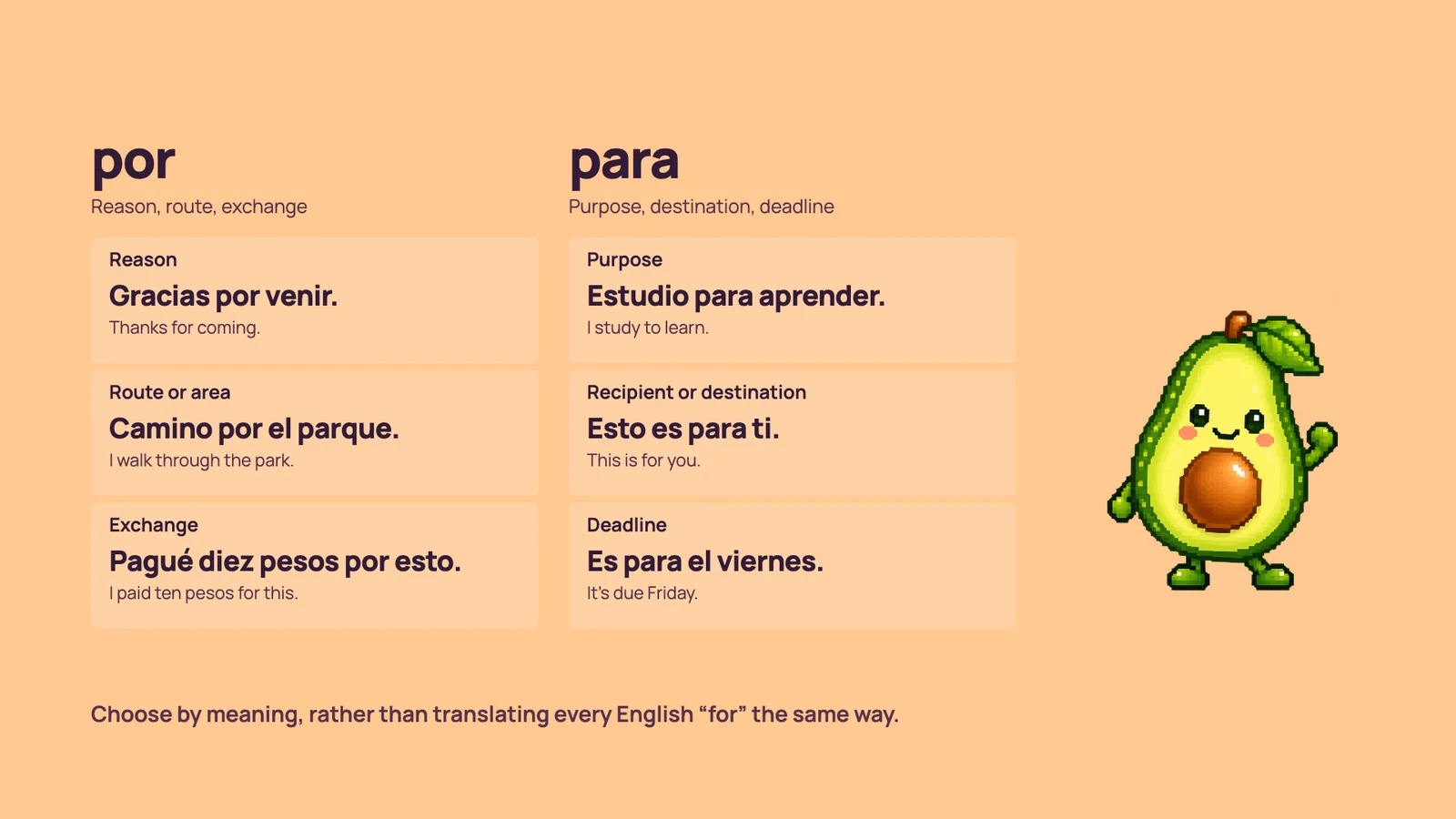
Por often gives a reason, route, or exchange. Para points to a purpose, recipient, destination, or deadline. Choose the relationship you mean; translating the English word “for” is not enough.
Thanks for coming.
I study to learn.
3. saber vs. conocer
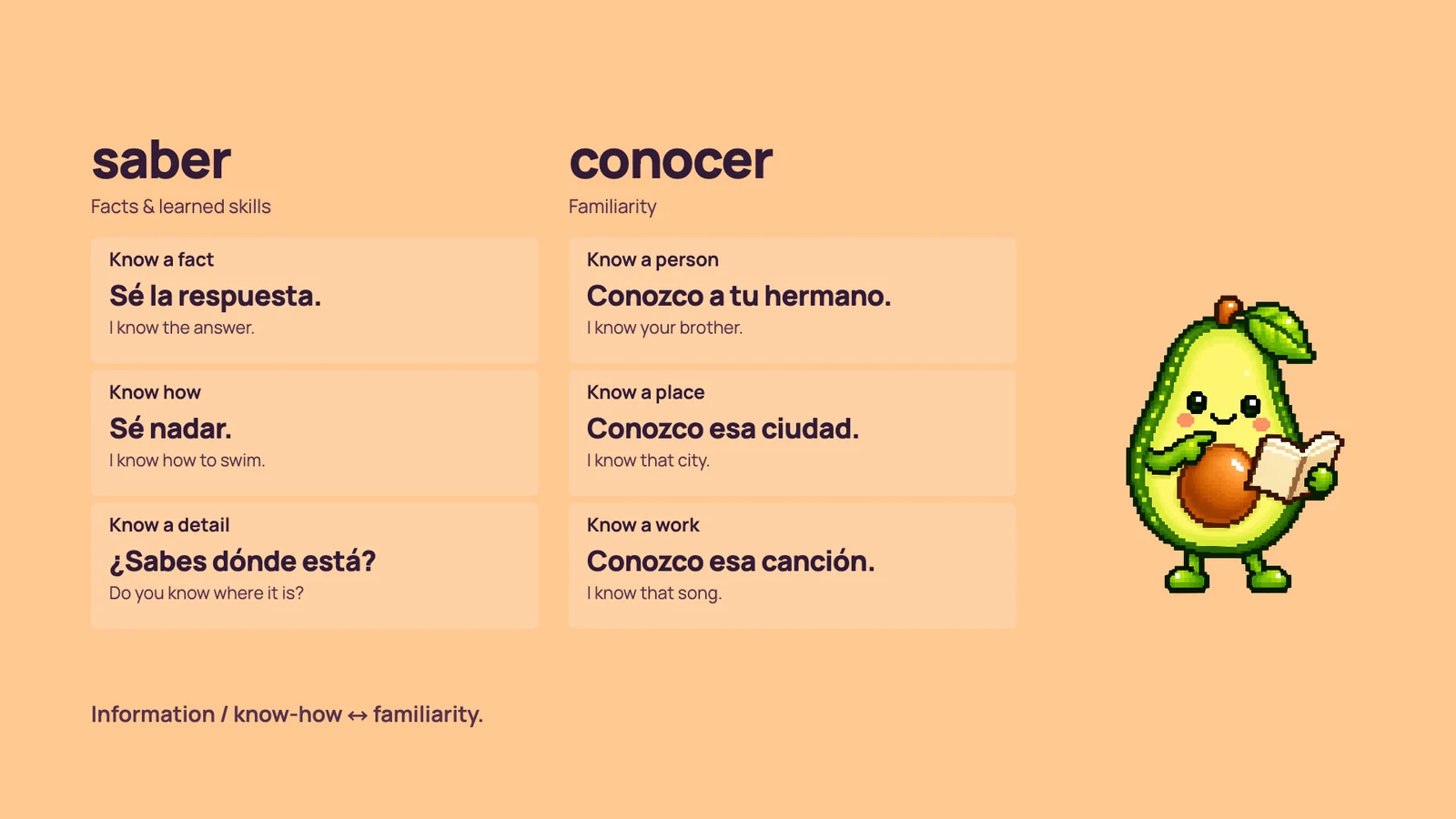
Saber covers facts and learned skills; conocer expresses familiarity with people, places, or things. For a skill, use saber + infinitive, as in sé nadar (I know how to swim).
I know the answer.
I know your brother.
4. pedir vs. preguntar
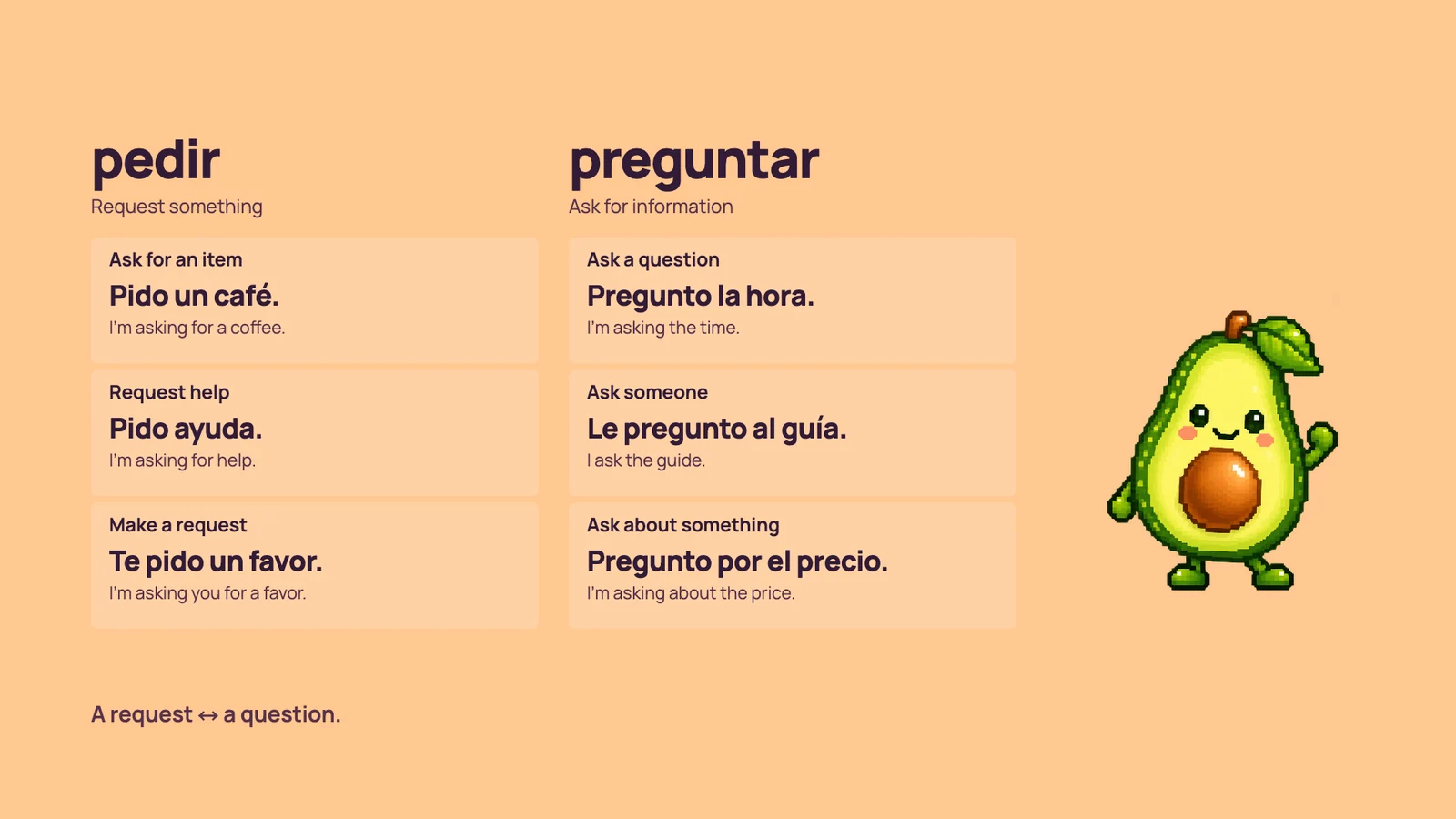
Pedir requests something; preguntar asks for information. At a café, you can pedir un café and preguntar por el precio: request a coffee and ask about its price.
I’m asking for a coffee.
I’m asking the time.
5. haber vs. tener
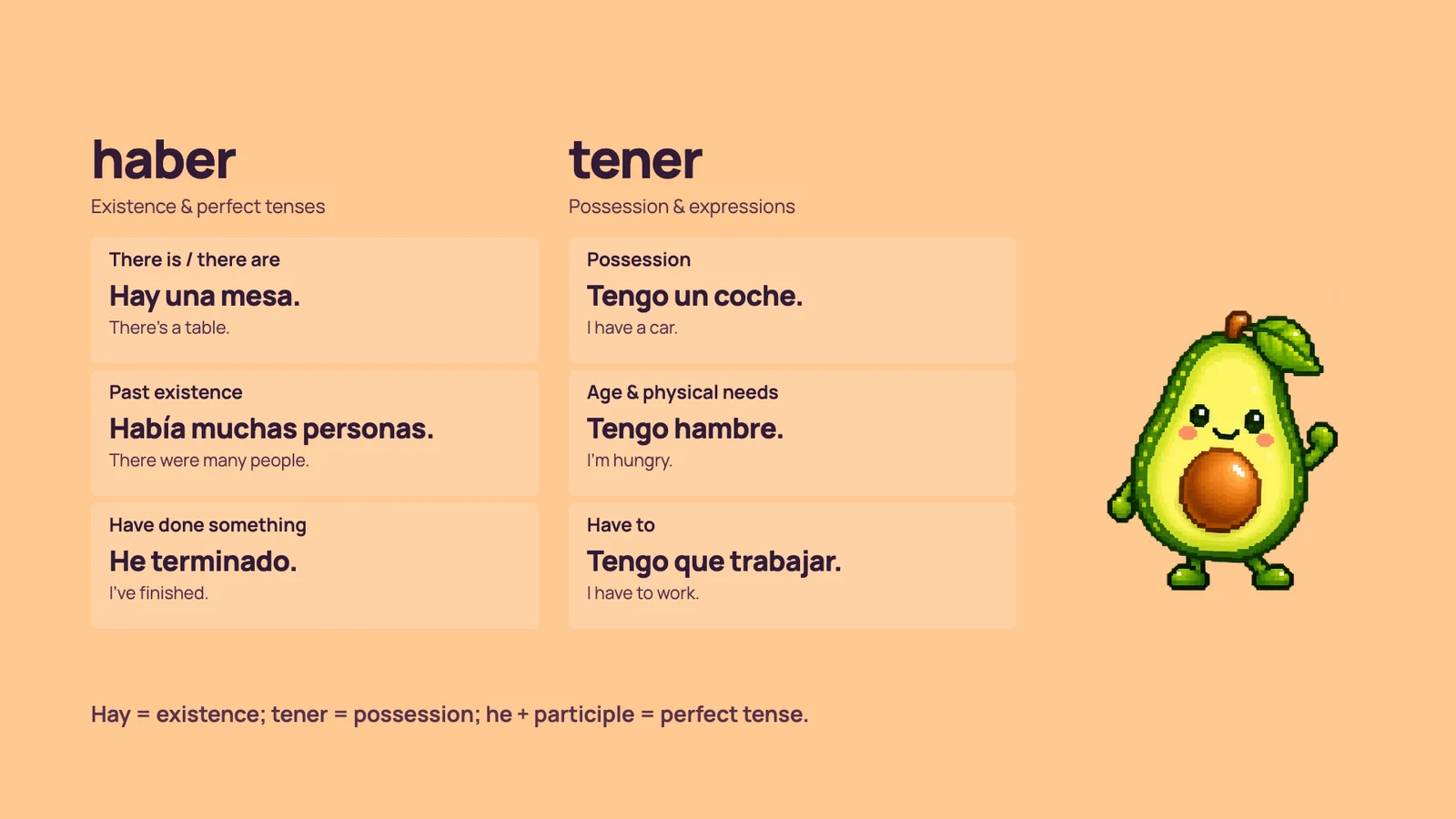
Haber gives existence in hay and helps form perfect tenses in he terminado. Tener expresses possession and appears in phrases such as tener hambre and tener que + infinitive. Learn each construction together.
There’s a table.
I have a car.
6–10: Movement, returning, and finding
6. ir vs. venir
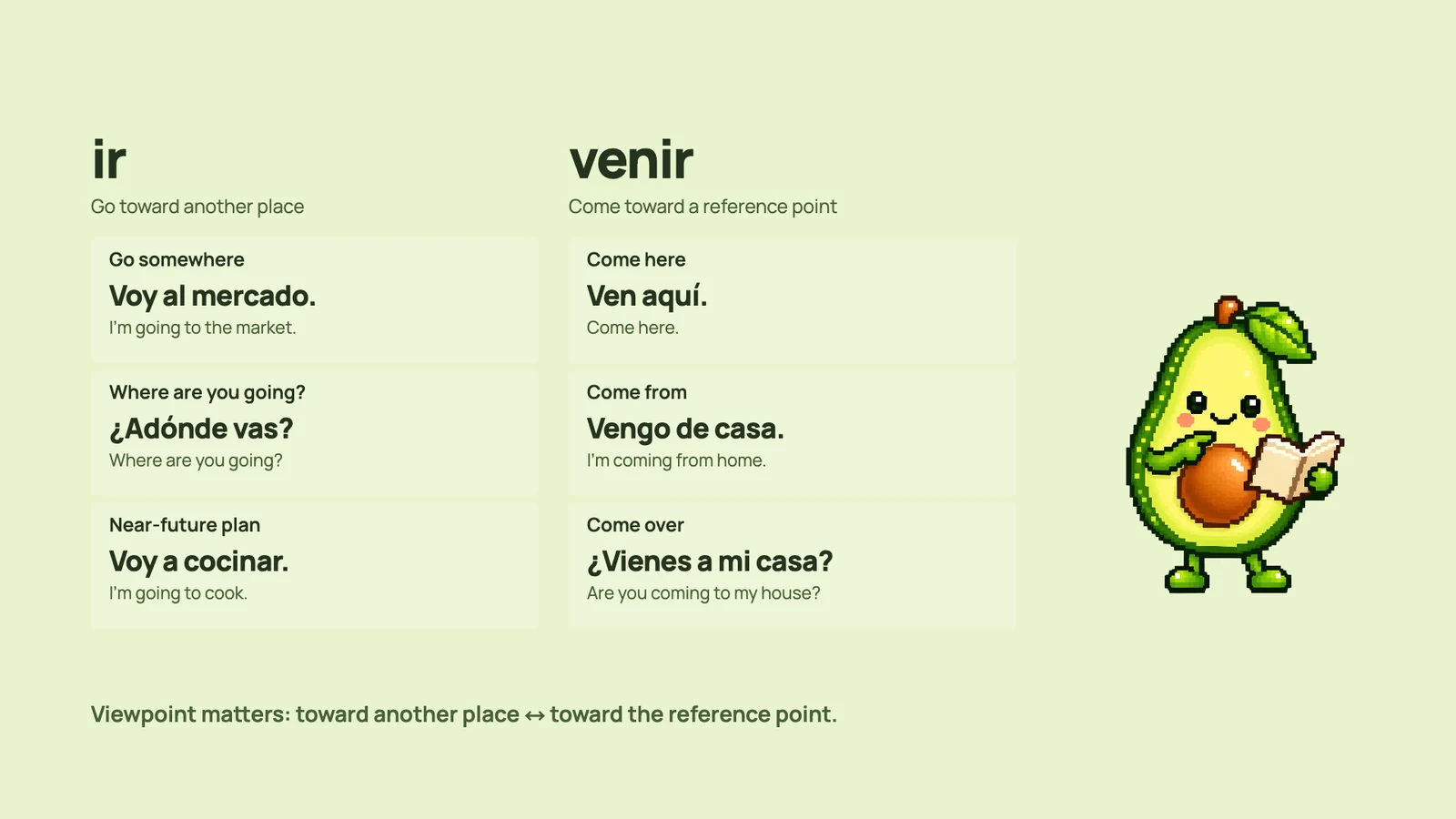
Ir moves toward another place; venir moves toward the speaker’s reference point. Picture the destination and the viewpoint. English “coming” does not always require venir in Spanish.
I’m going to the market.
Come here.
7. llevar vs. traer
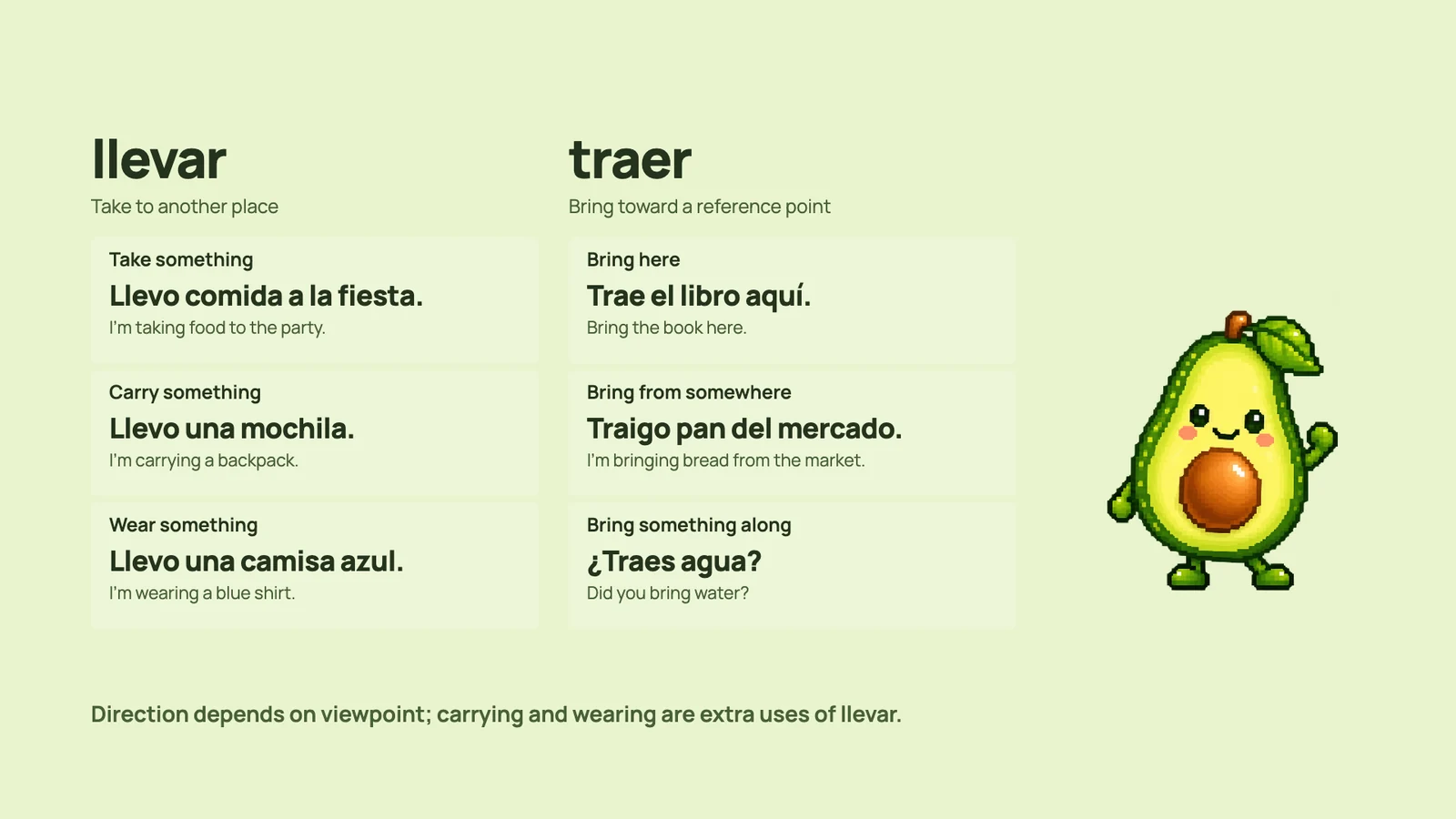
Llevar takes something to another place; traer brings it toward the reference point. Llevar also describes carrying or wearing, so check the full sentence before choosing.
I’m taking food to the party.
Bring the book here.
8. dejar vs. salir
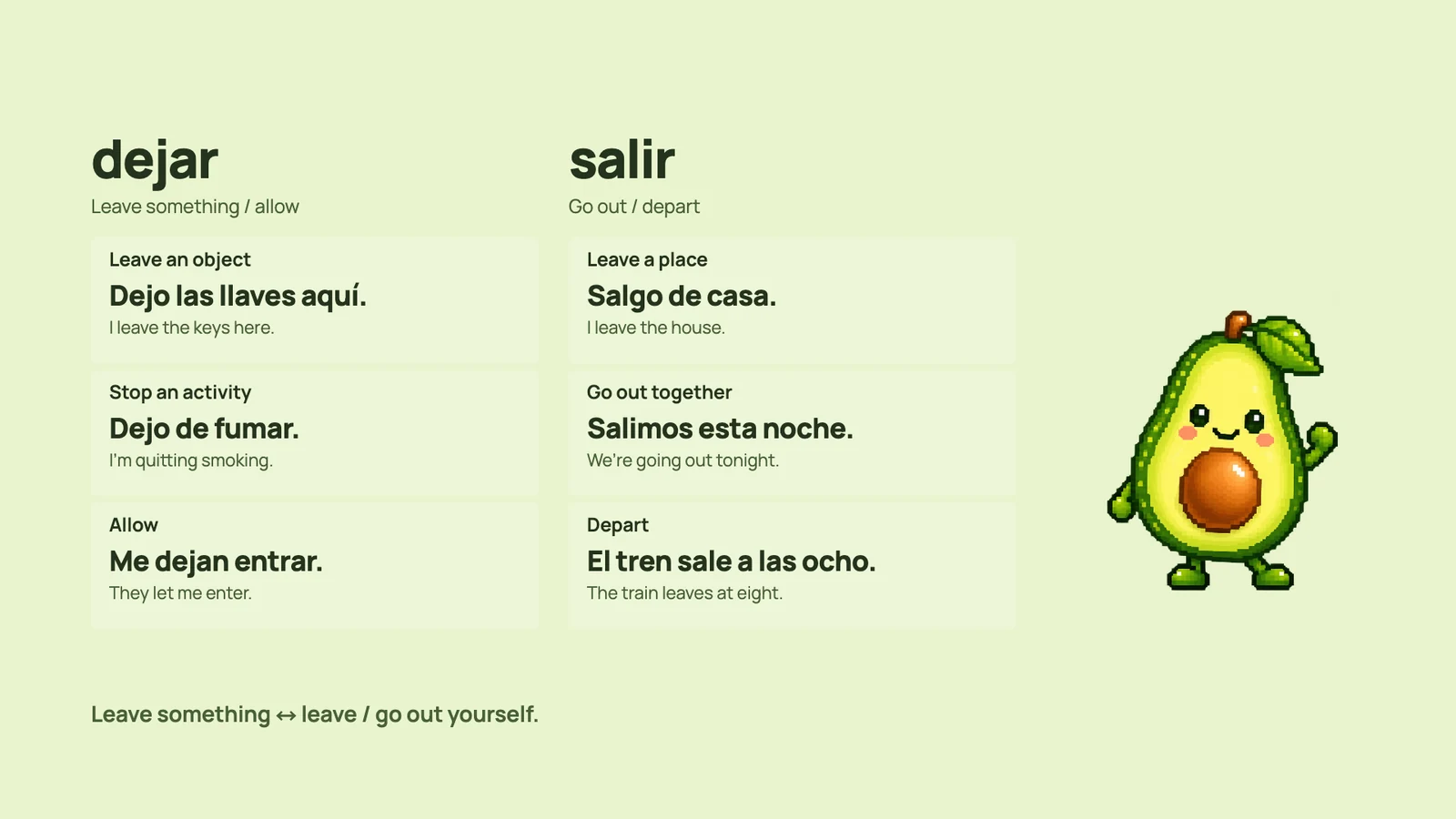
Dejar can mean leave something behind, allow, or stop an activity in dejar de + infinitive. Salir describes the person or vehicle going out or departing.
I leave the keys here.
I leave the house.
9. volver vs. devolver
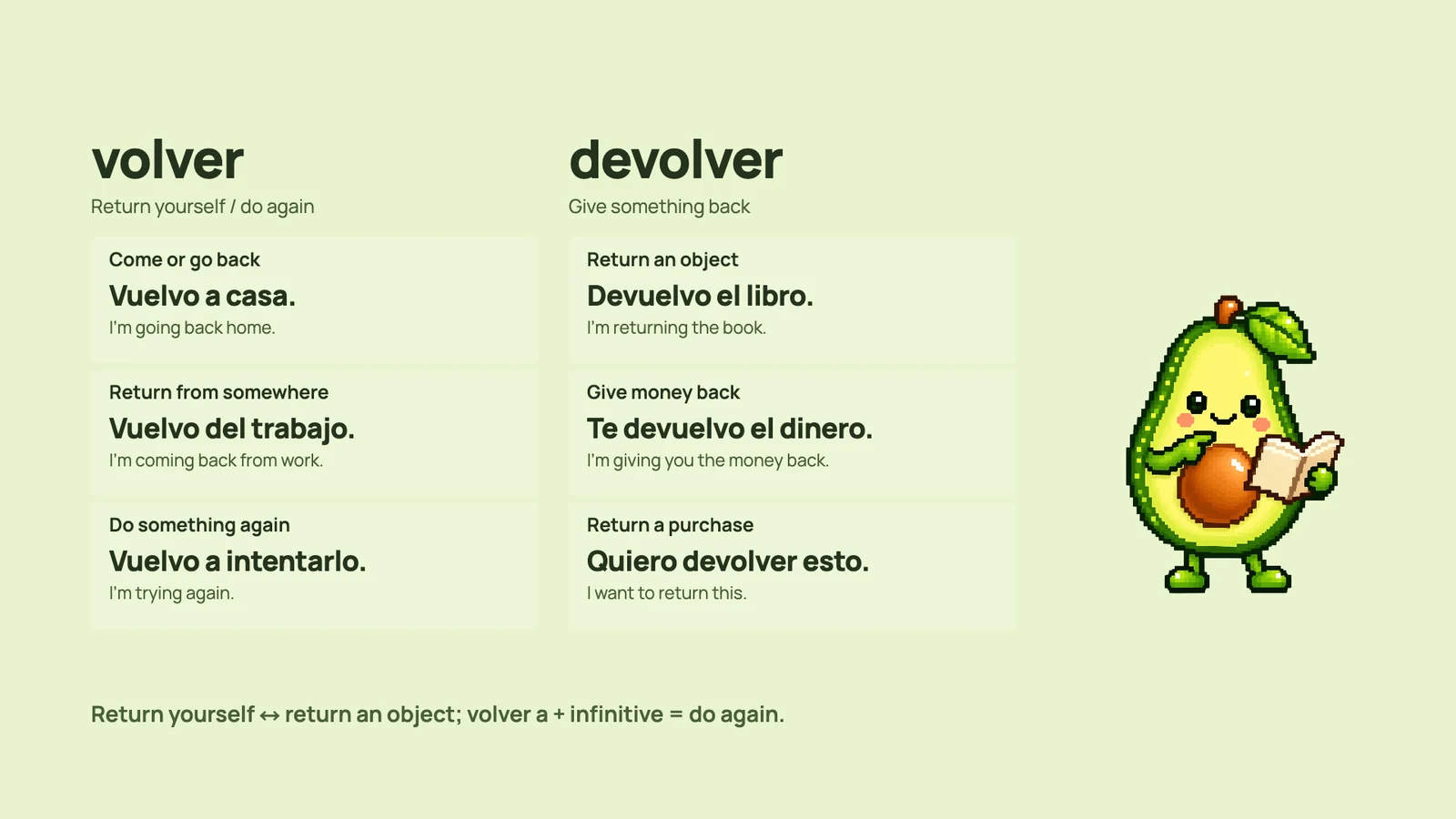
Volver describes returning yourself; devolver means giving something back. Volver a + infinitive adds a useful third pattern: doing an action again, as in vuelvo a intentarlo (I’m trying again).
I’m going back home.
I’m returning the book.
10. buscar vs. encontrar
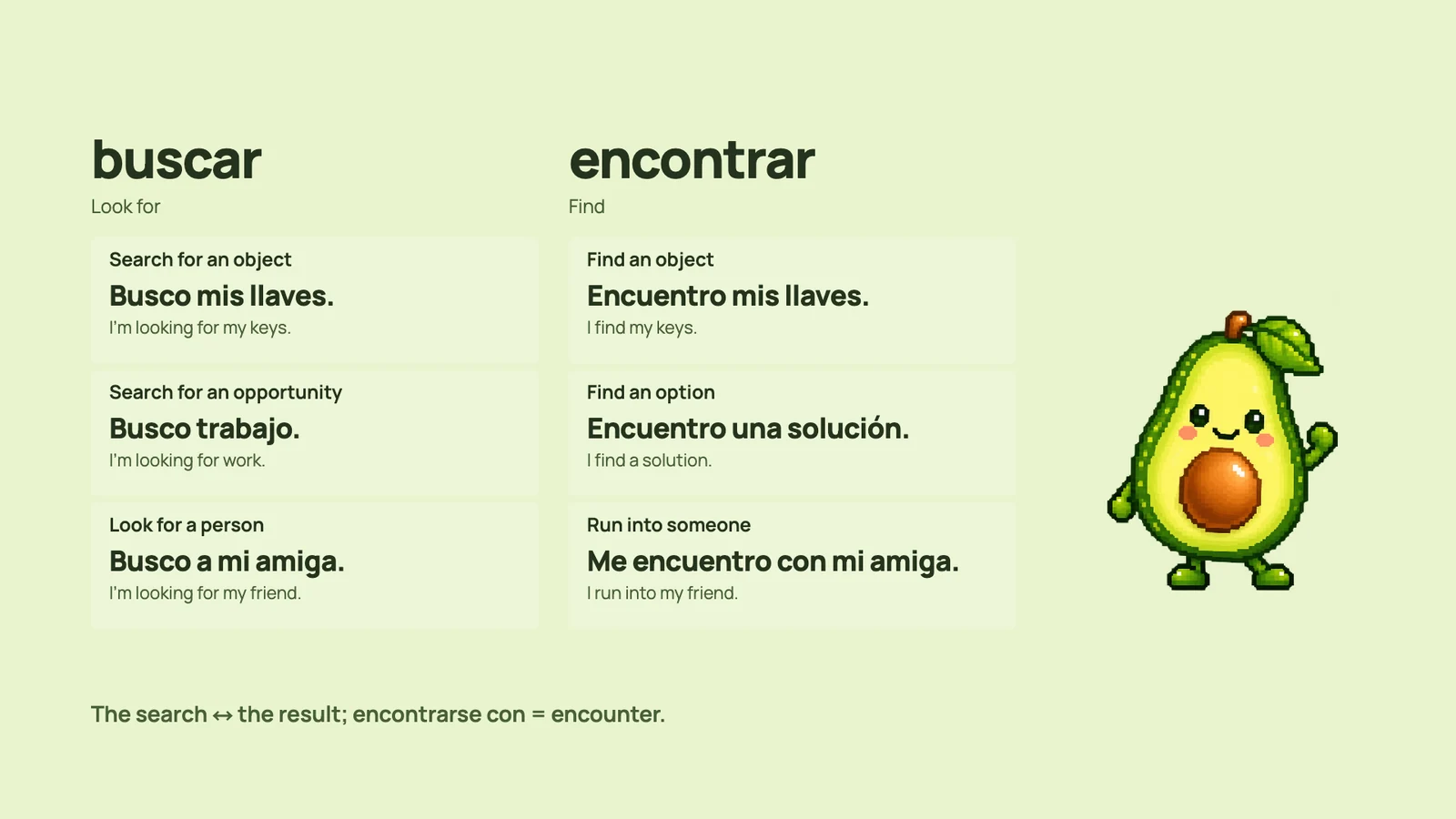
Buscar is the search; encontrar is the discovery. Looking does not guarantee finding. Encontrarse con adds another meaning: meeting or running into someone.
I’m looking for my keys.
I find my keys.
11–15: Seeing, listening, trying, and learning
11. ver vs. mirar
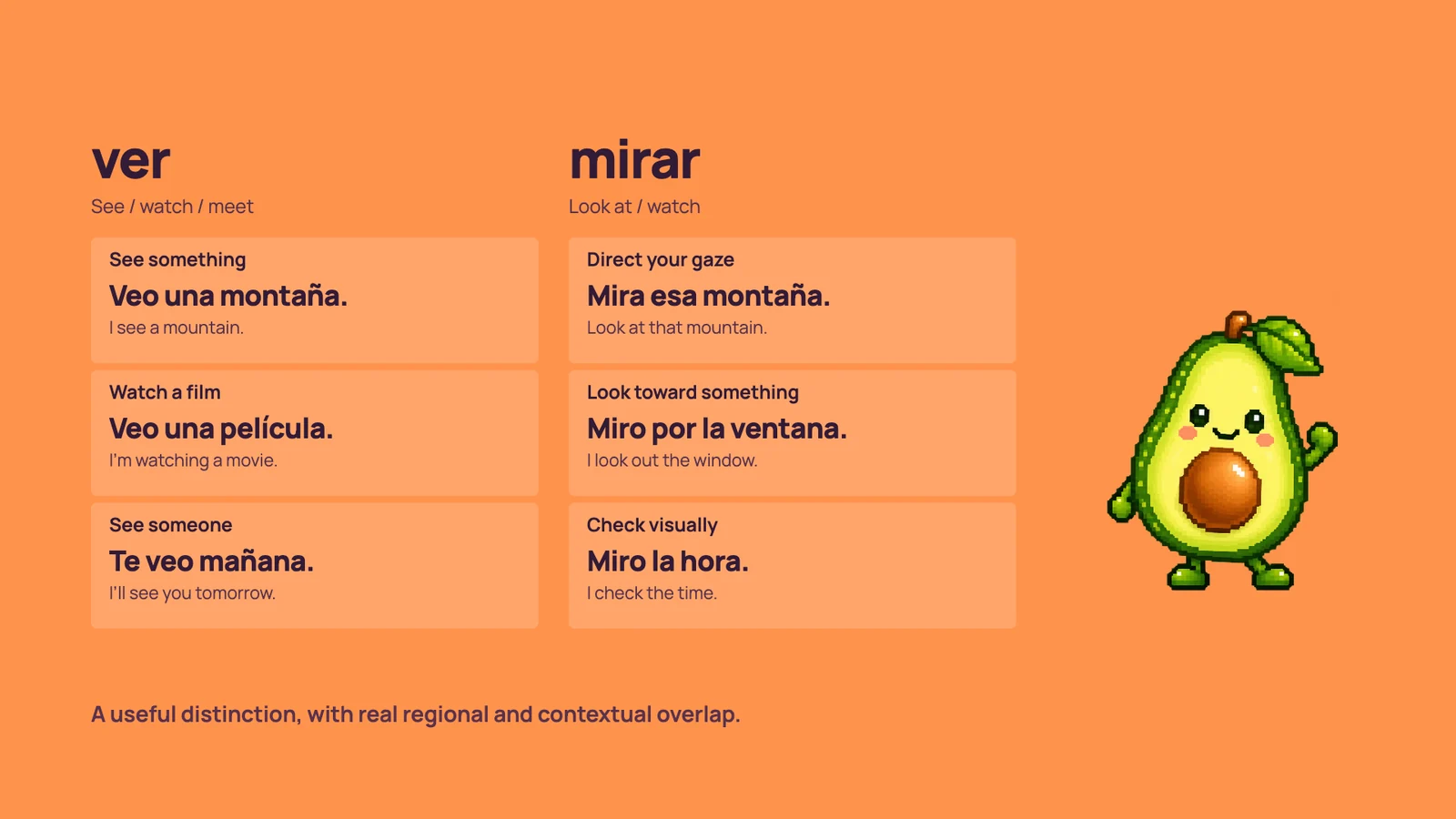
Ver often describes seeing; mirar often directs attention toward something. Treat this as a starting point: both can describe watching, with regional and contextual overlap.
I see a mountain.
Look at that mountain.
12. oír vs. escuchar
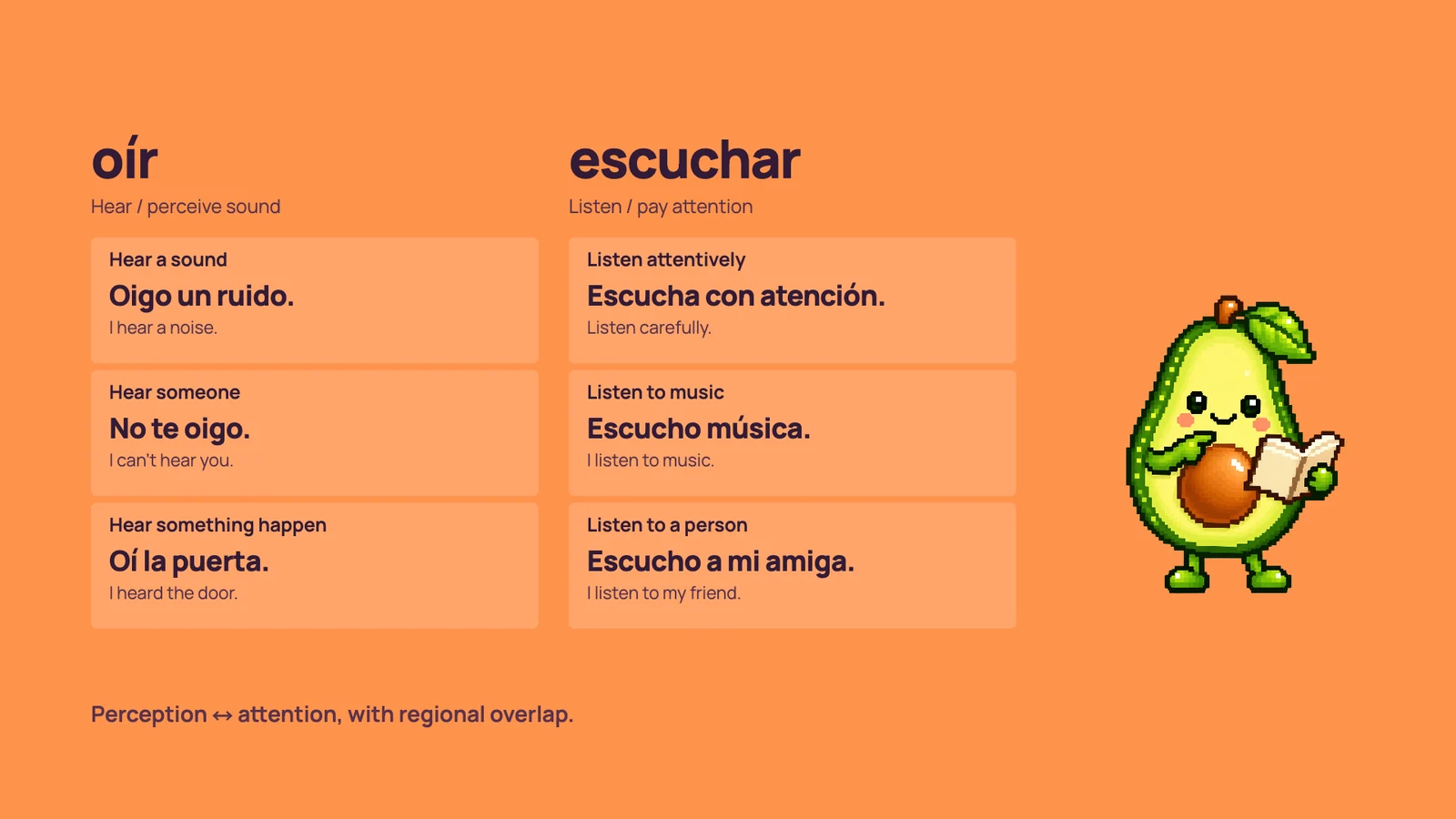
Oír often focuses on perceiving sound; escuchar often focuses on paying attention. The distinction is useful, but everyday usage overlaps across regions.
I hear a noise.
Listen carefully.
13. jugar vs. tocar
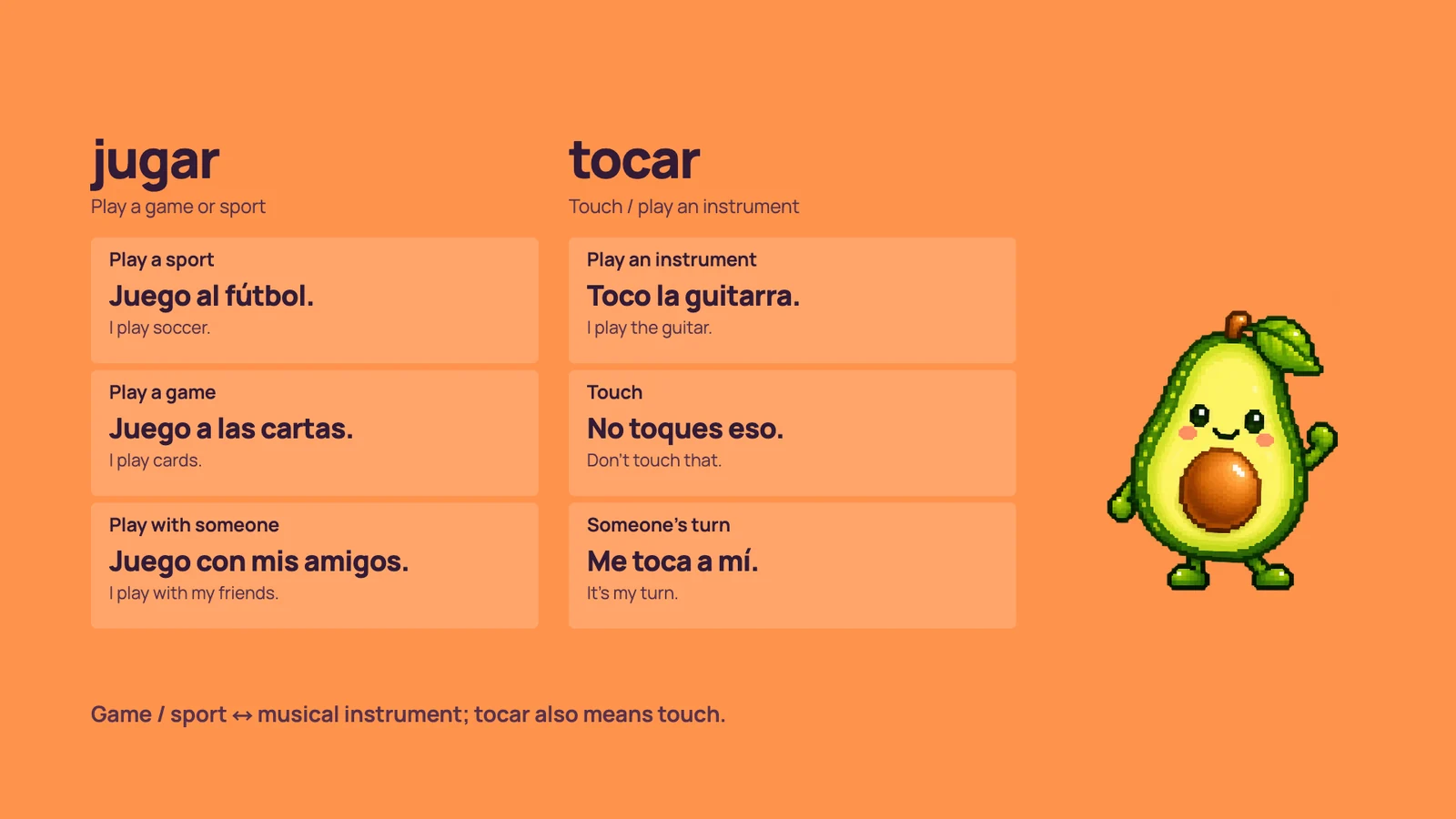
Use jugar for playing games or sports and tocar for playing an instrument. Tocar also means touch; me toca means it is my turn.
I play soccer.
I play the guitar.
14. probar vs. intentar
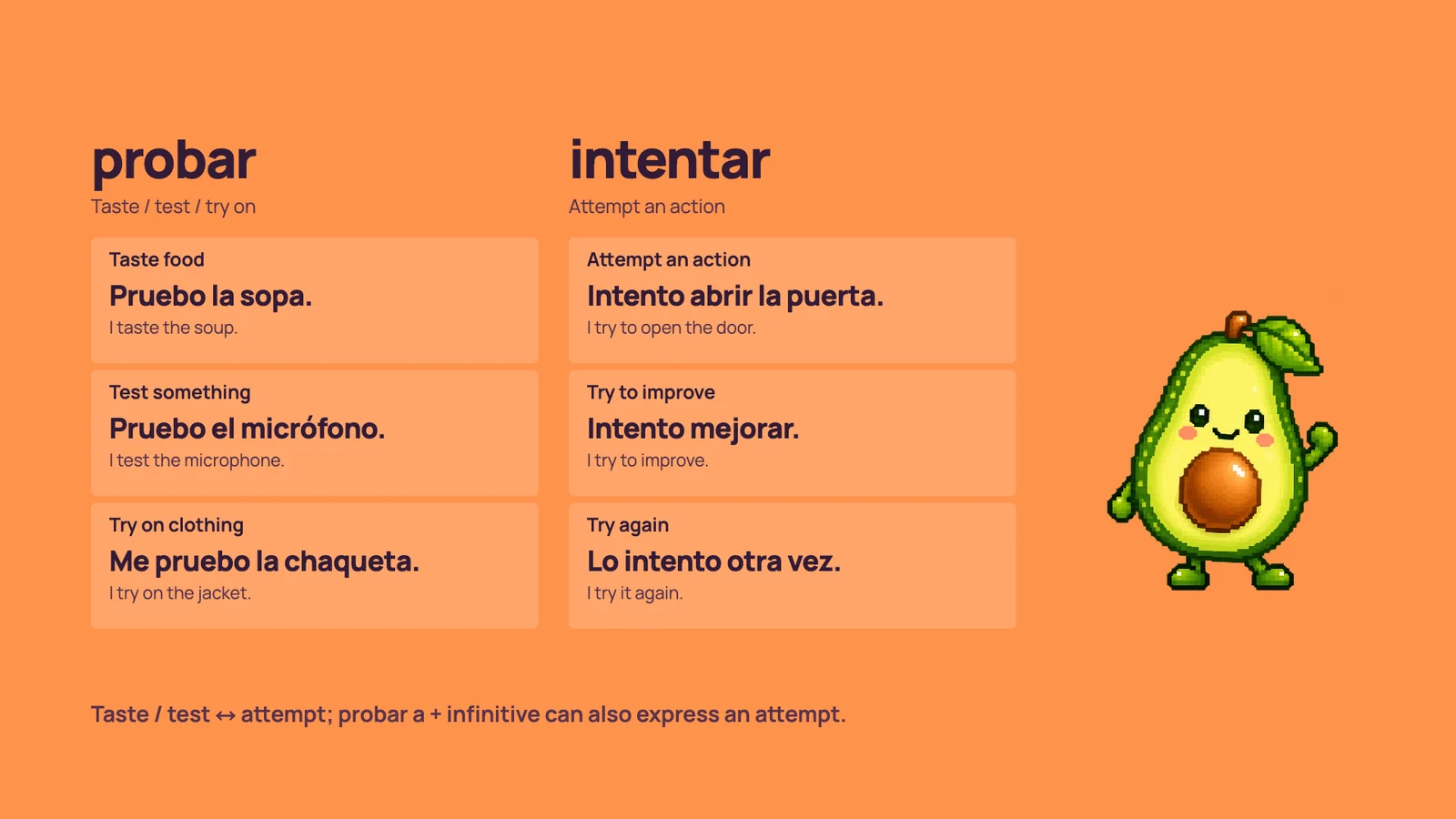
Probar covers tasting, testing, and trying something on with probarse. Intentar describes attempting an action. Probar a + infinitive can also express an attempt, so this is a guide, not an absolute divide.
I taste the soup.
I try to open the door.
15. aprender vs. enseñar
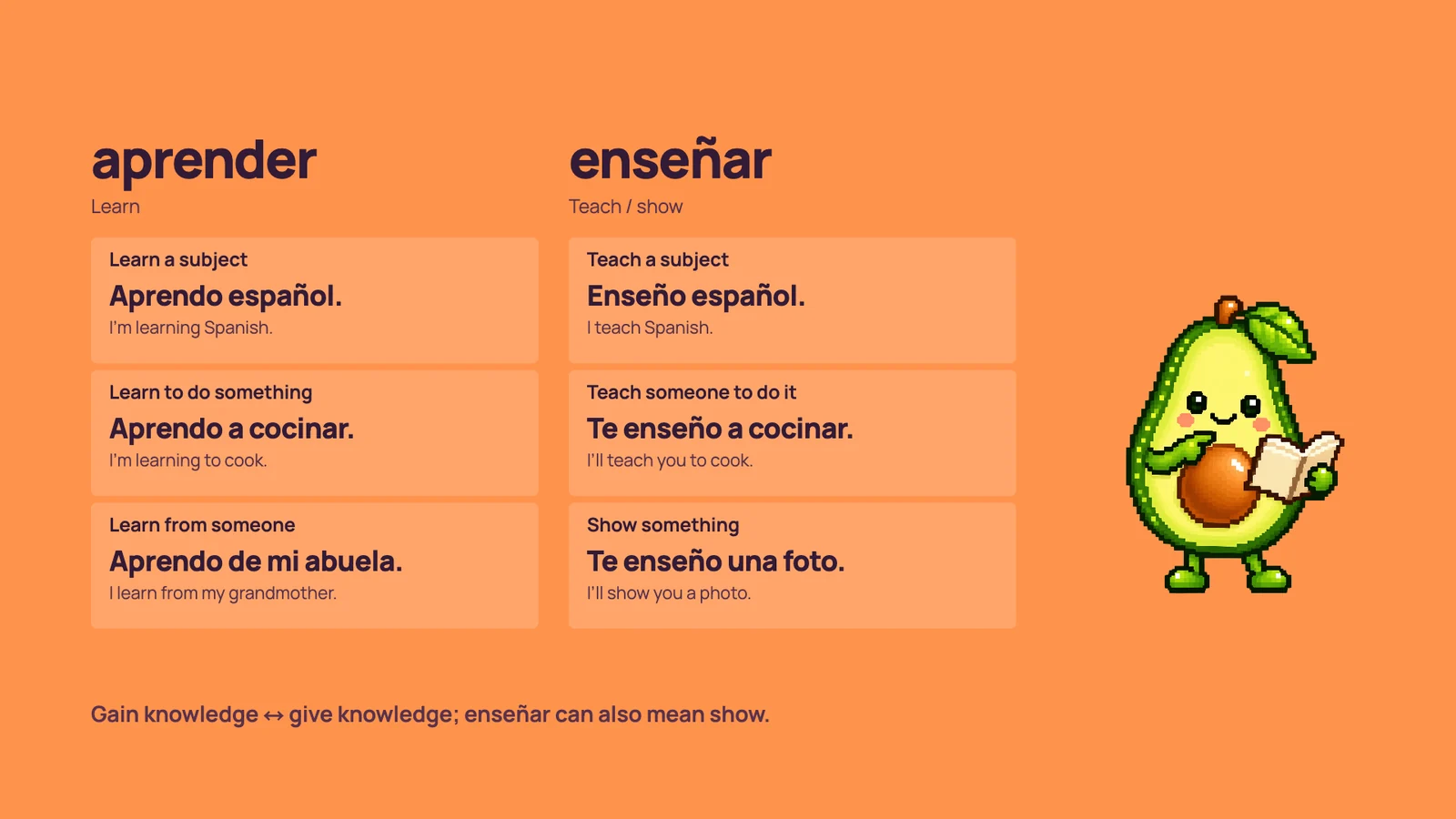
Aprender means gaining knowledge; enseñar means teaching it. Enseñar can also mean show: te enseño una foto means “I’ll show you a photo.”
I’m learning Spanish.
I teach Spanish.
16–20: Feelings, descriptions, and quantity
16. sentir vs. sentirse
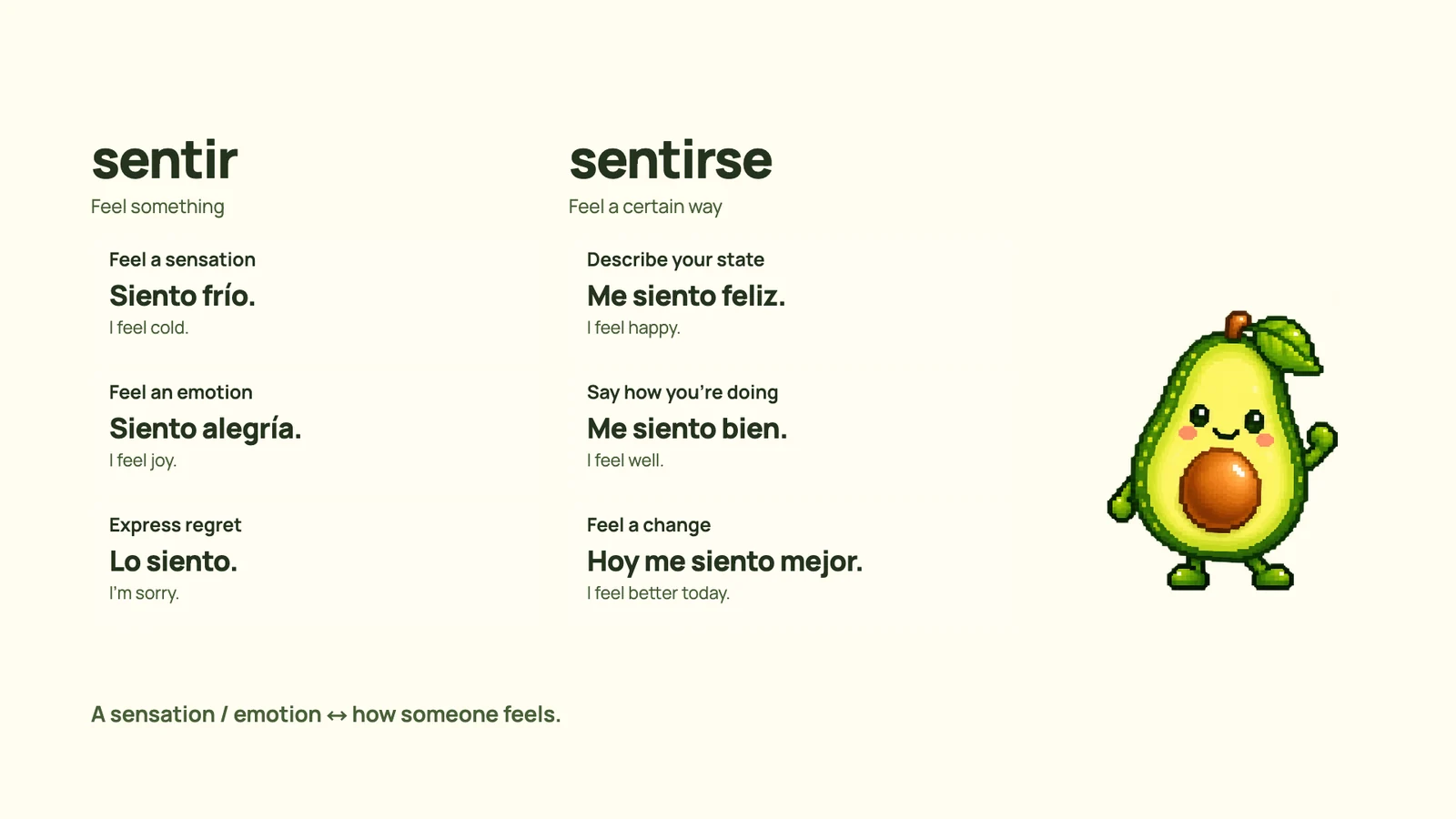
Sentir names a sensation or emotion you feel. Sentirse describes how someone feels, with a pronoun that matches the person: me siento, te sientes, se siente. Lo siento is the familiar apology.
I feel cold.
I feel happy.
17. bueno vs. bien
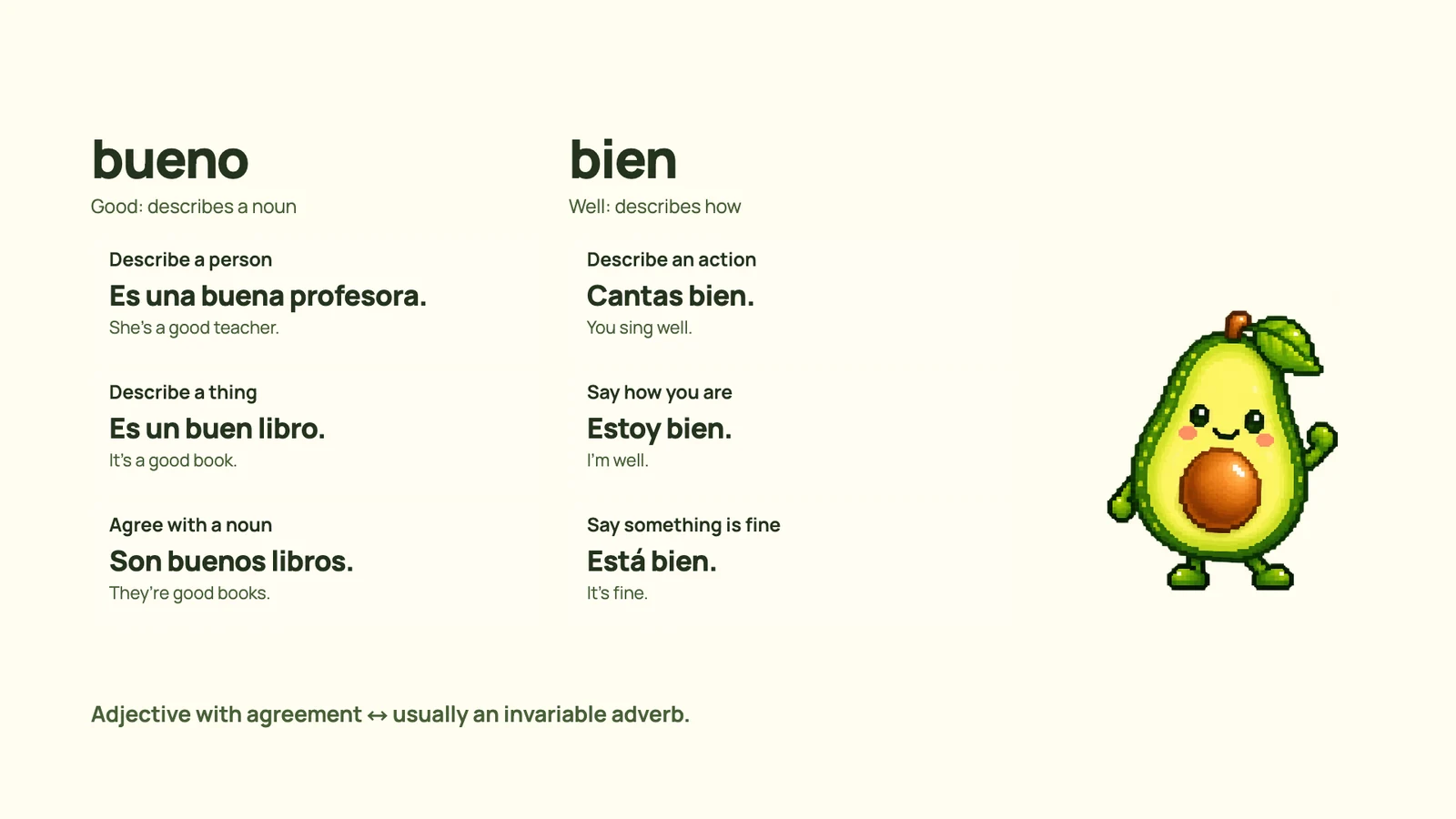
Bueno describes a noun and agrees with it: buena profesora, buenos libros. It shortens to buen before a masculine singular noun. Bien usually describes how something goes and does not change for gender or number.
She’s a good teacher.
You sing well.
18. malo vs. mal
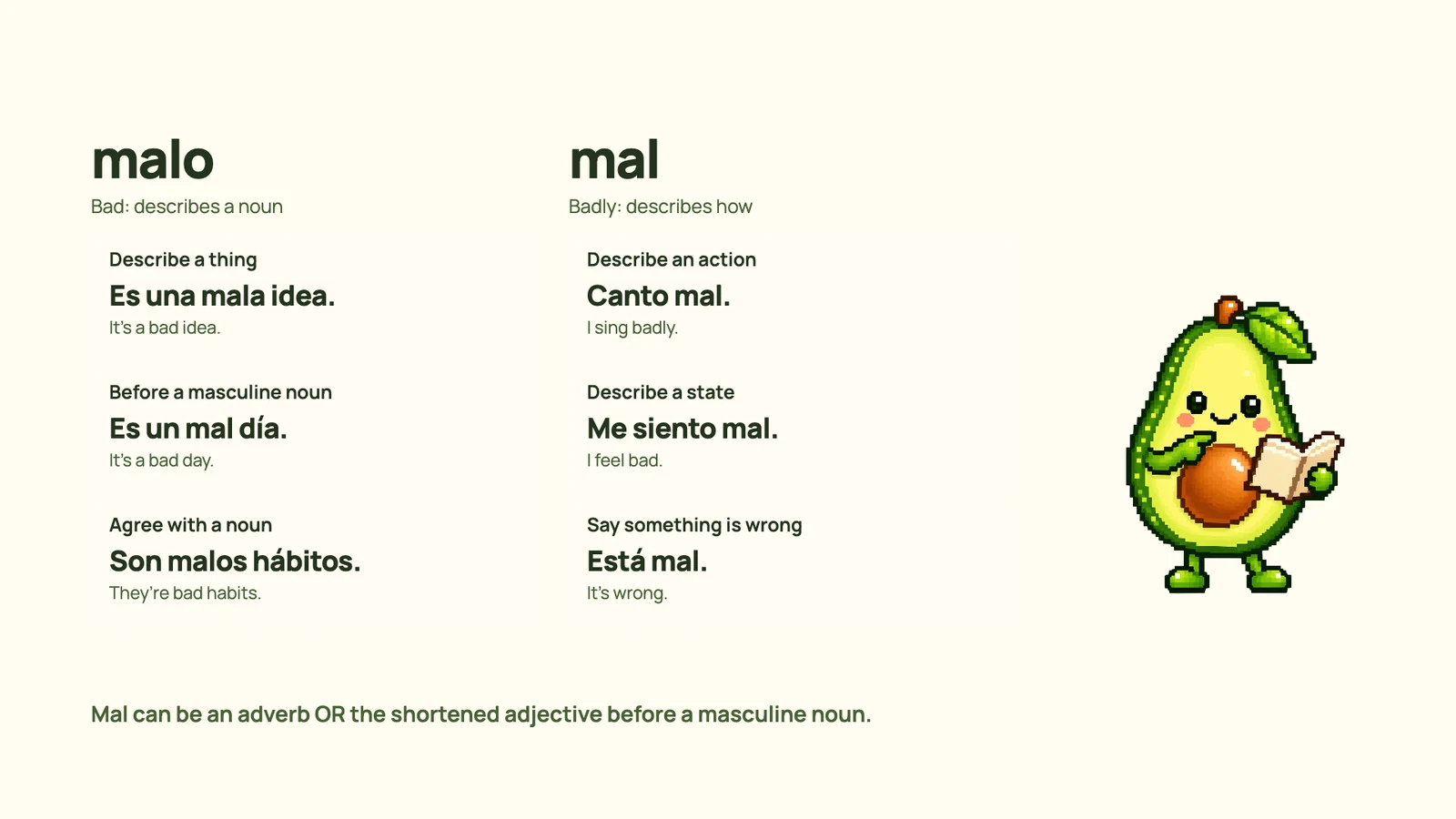
Malo describes a noun and agrees with it. Mal often means badly, but it is also the shortened adjective before a masculine singular noun: un mal día. Look at its job in the sentence.
It’s a bad idea.
I sing badly.
19. muy vs. mucho
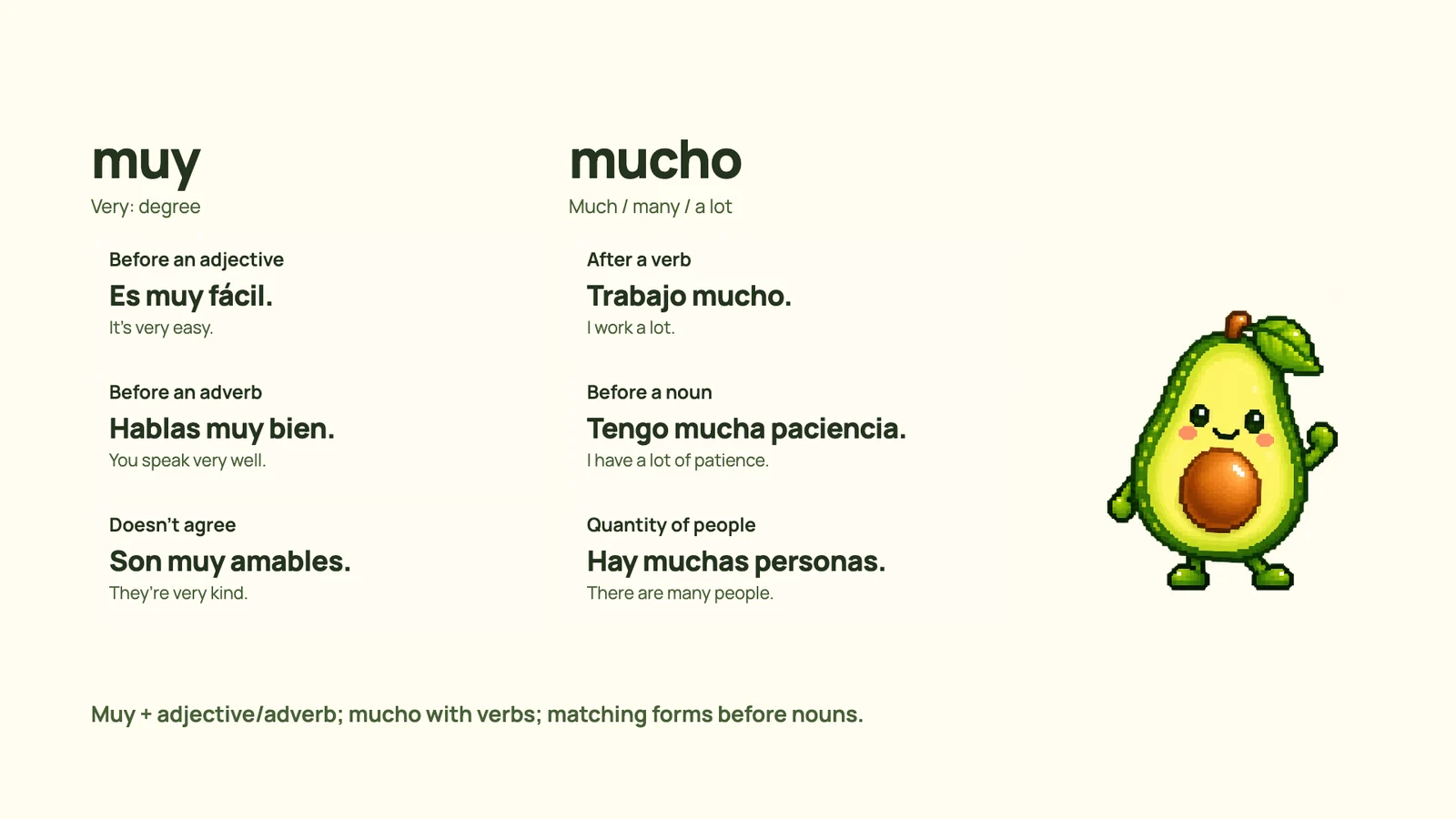
Muy goes before an adjective or adverb: muy fácil, muy bien. Mucho can describe an action, or agree with a following noun: trabajo mucho, mucha paciencia. Learn special patterns such as mucho mejor together.
It’s very easy.
I work a lot.
20. tan vs. tanto
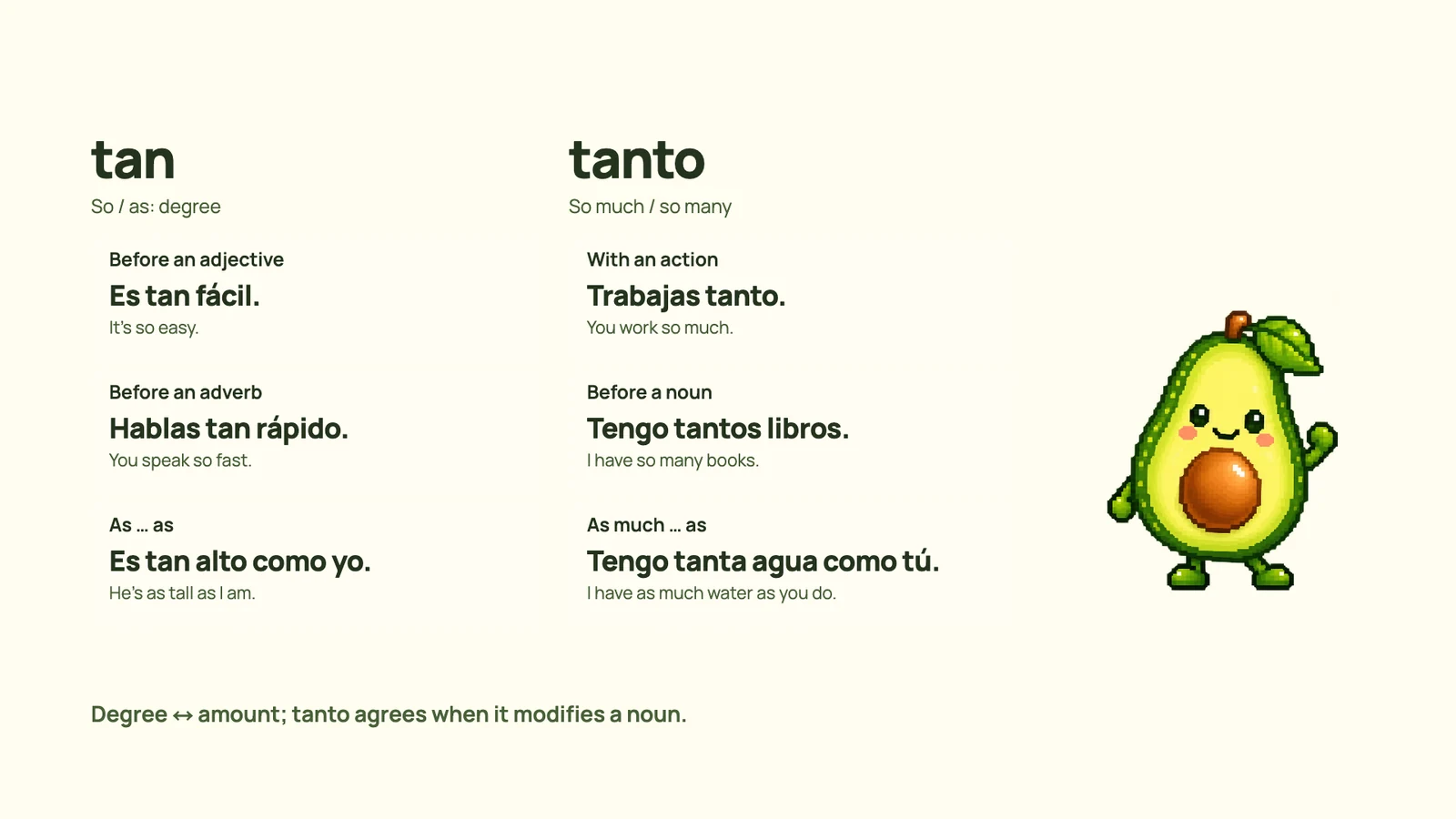
Tan expresses degree before an adjective or adverb. Tanto expresses amount, agreeing when it modifies a noun: tantos libros, tanta agua. In comparisons, notice tan… como and tanto/a… como.
It’s so easy.
You work so much.
21–25: Time, contrast, and agreement
21. ya vs. todavía
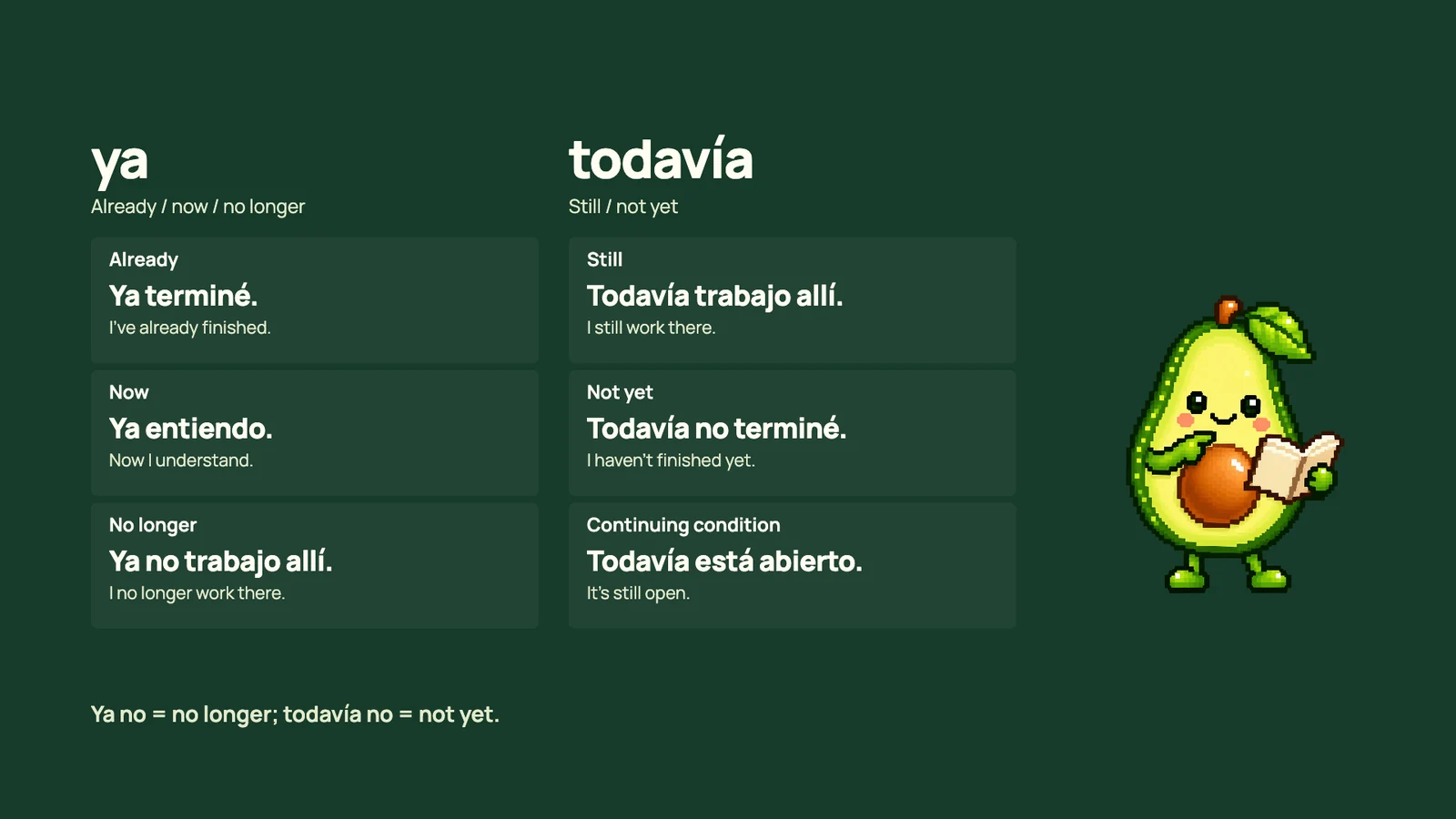
Ya can mean already or now; todavía often means still. The negative phrases change the message: ya no means no longer, while todavía no means not yet.
I’ve already finished.
I still work there.
22. aun vs. aún
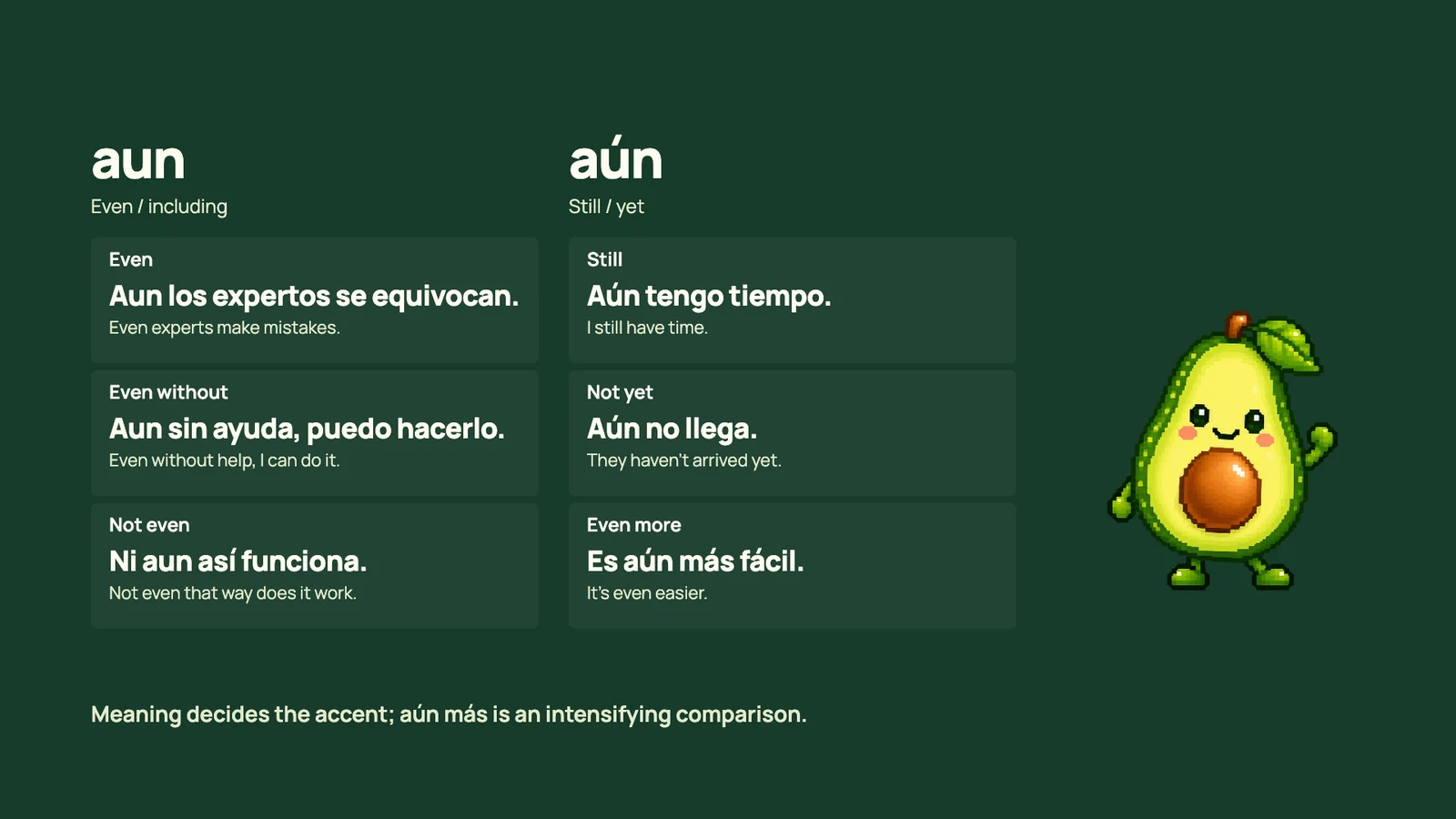
Aun often means even or including; aún commonly means still or yet. Learn the intended meaning with the accent. In aún más fácil (even easier), the accented word intensifies the comparison.
Even experts make mistakes.
I still have time.
23. tiempo vs. vez
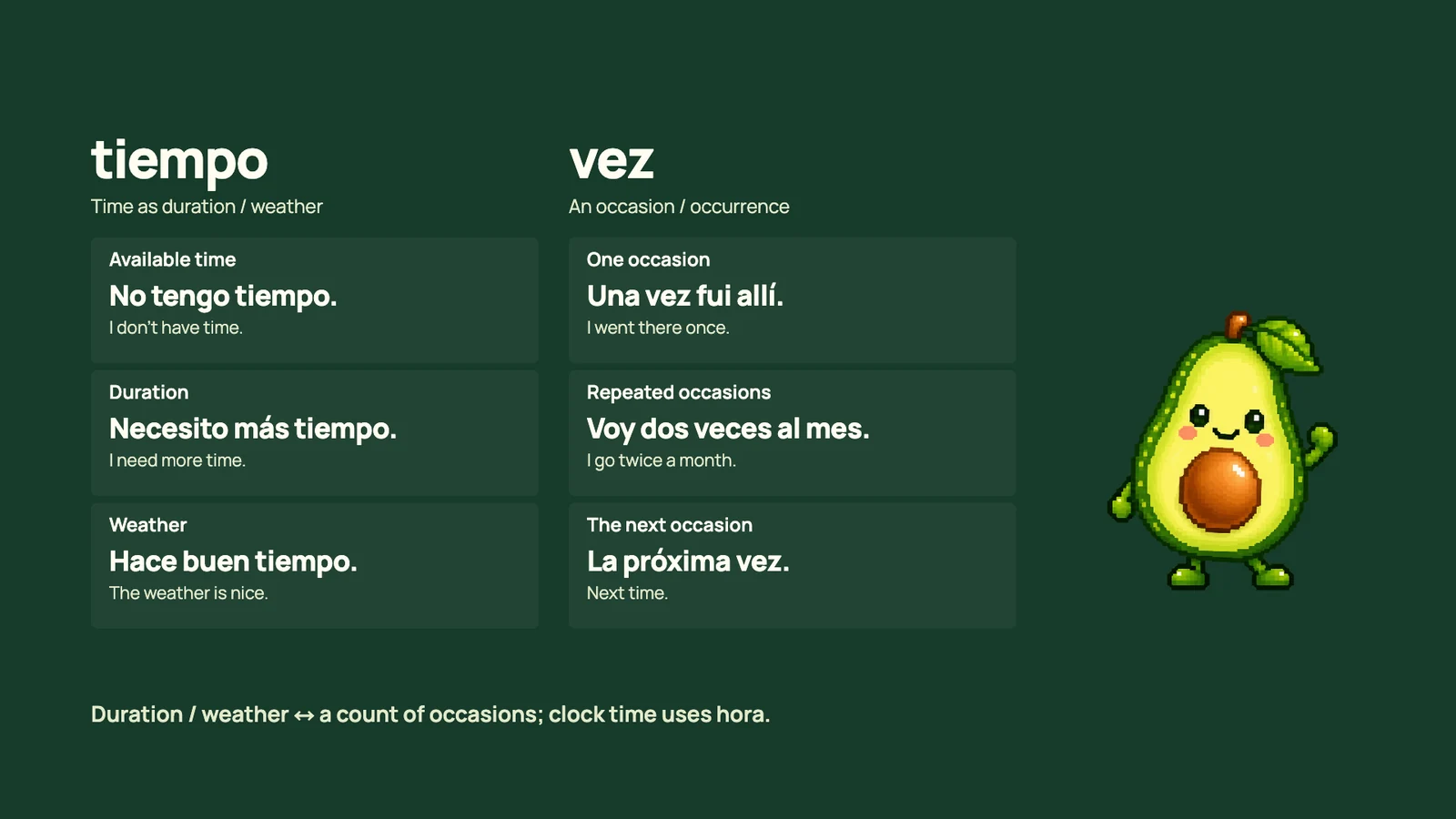
Tiempo expresses duration or weather; vez counts occasions. Una vez means once and dos veces means twice. To ask for the clock time, use ¿Qué hora es?
I don’t have time.
I went there once.
24. pero vs. sino
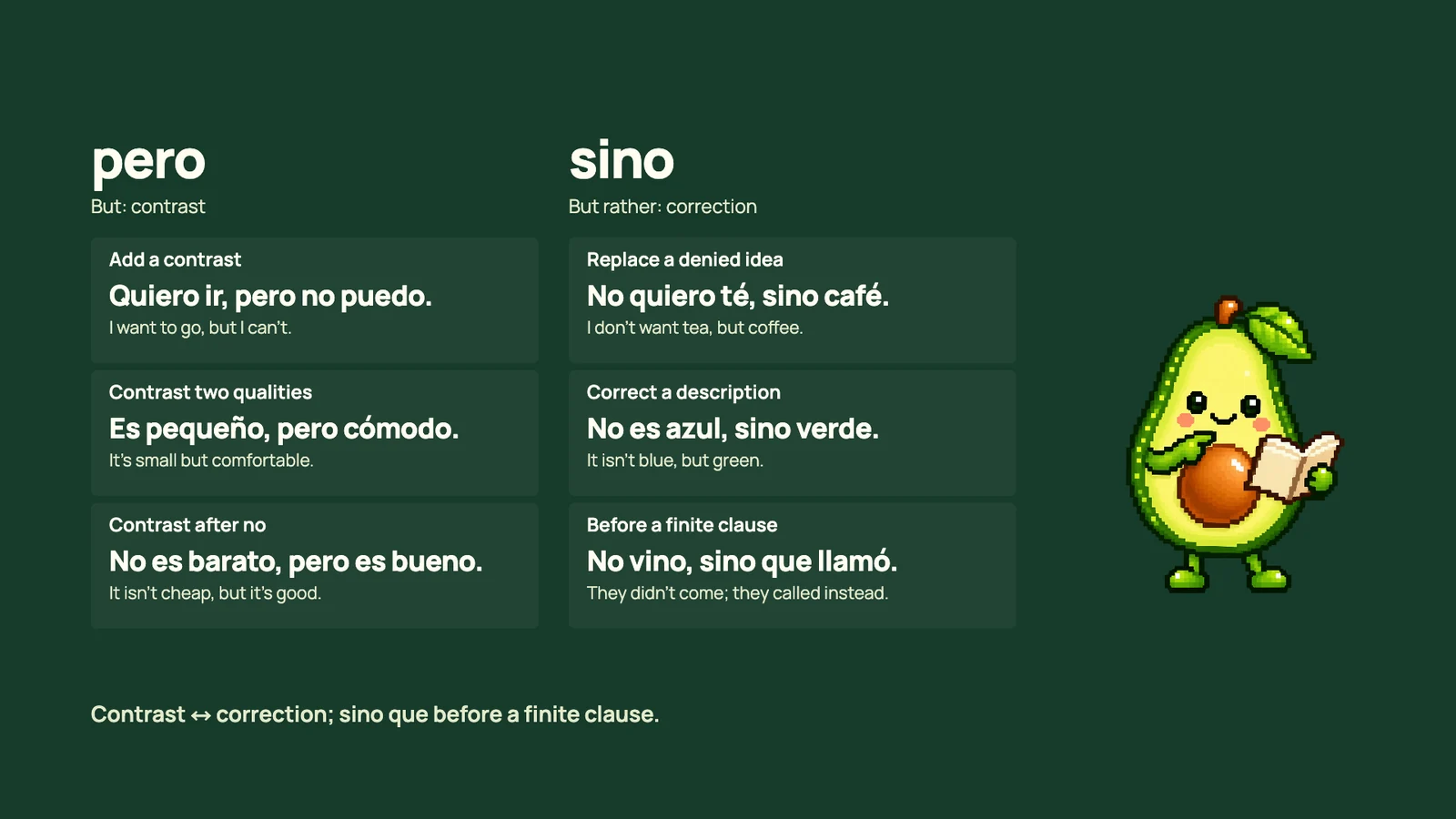
Pero contrasts two ideas. Sino corrects and replaces a denied idea: no té, sino café. Use sino que before a full correction clause: no vino, sino que llamó (they called instead of coming).
I want to go, but I can’t.
I don’t want tea, but coffee.
25. también vs. tampoco
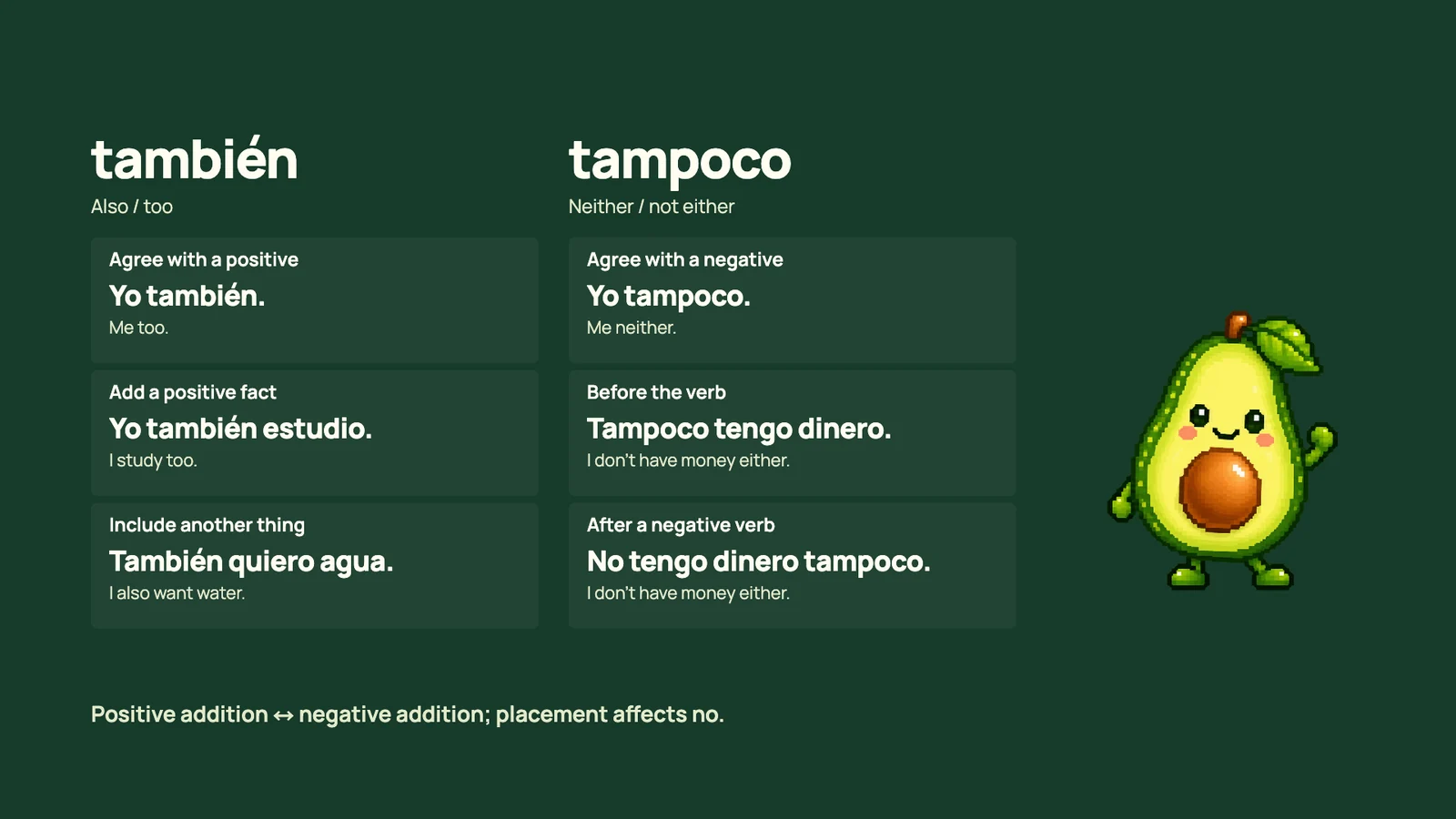
También adds to a positive statement; tampoco adds to a negative one. Say yo también for “me too” and yo tampoco for “me neither.” Before the verb, tampoco already supplies the negative meaning.
Me too.
Me neither.
Make three pairs part of your day
Choose three contrasts. Read each example aloud, cover its translation, and explain why that word fits. Then change one detail to make the sentence yours. Return tomorrow before adding more.
Need a closer look? Try our ser vs. estar guide and quiz, por vs. para guide, or bueno vs. bien guide. For daily vocabulary and spoken practice, create a free LSFR account or open Daily Study in Voice Mode.
Useful reminders
Is ser vs. estar just permanent vs. temporary?
No. Focus on identification or classification versus a state or situation. A long-lasting condition can use estar, and a characteristic that changes can use ser. Events also have their own location pattern.
Do these comparisons always have one fixed English equivalent?
No. Context, construction, and regional usage matter. Ver and mirar, oír and escuchar, and probar and intentar have overlap. Use the full sentence and the chart’s caution, rather than treating either column as an exclusive dictionary definition.
Can I watch the lesson free?
Yes. The full YouTube lesson and these charts are free to view. Subscribe on YouTube if you would like to follow future Avo lessons; YouTube asks you to confirm the subscription.
Let’s make it click, together.
Ask a question, share an example, or tell us what helped.
A kind space to learn. Keep it helpful, keep it human.



Community notes